
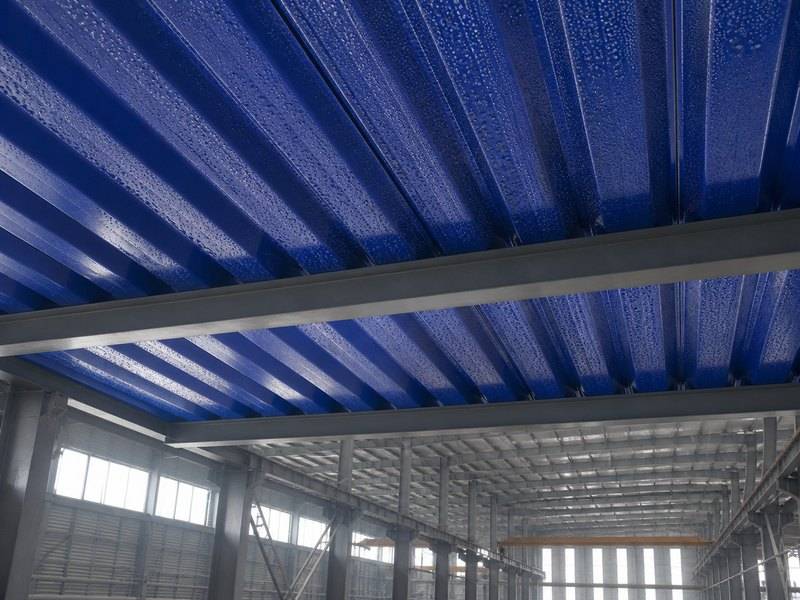
Roofing sheet condensation forms when moist air touches the underside of a sheet or another roof component that is colder than the air’s dew point. The first response is not to seal every lap. First determine whether the water came through the roof or formed beneath it.
Widespread fine droplets on a clear, cool morning usually indicate surface condensation. Water that appears only during rain and follows one lap, fastener or flashing more often indicates leakage. A roof can have both problems, so timing and location matter.
| What you observe | More likely explanation | First check |
|---|---|---|
| Water appears during or soon after rain | Bulk rainwater entry | Trace the highest wet point, then inspect laps, fasteners and flashings |
| Fine beads cover a broad underside area on cool mornings | Surface condensation | Compare indoor dew point with sheet-surface temperature |
| Dripping increases after washing, production or heavy occupancy | High indoor moisture load | Identify the source and review the air-exchange path |
| Insulation is wet but the visible liner looks dry | Concealed condensation or a hidden leak | Open a limited inspection area and trace both air and water paths |
What creates roofing sheet condensation?
Three conditions must meet: a moisture source, a path that carries moist air to the roof, and a surface colder than the dew point. Removing any one of these conditions can reduce the risk. Durable control often addresses two or more.
The National Weather Service dew-point explanation defines dew point as the temperature to which air must cool to become saturated. Relative humidity changes with air temperature. Dew point gives a more direct reference for a cold roof surface.
| Indoor air | Approximate dew point |
|---|---|
| 25 C at 60% relative humidity | 16.7 C |
| 30 C at 70% relative humidity | 24.0 C |
| 20 C at 80% relative humidity | 16.4 C |
These examples use a standard approximation and are not project design values. In the second case, any roof component near 24 C can begin collecting moisture even though the indoor air feels warm.
Why the roofing-sheet material alone does not decide the result
Metal, fiber-cement, PVC and UPVC sheets do not reach the same surface temperature at the same rate. Color, mass, solar exposure, indoor heat transfer and insulation also change the result. Even so, no sheet material removes the dew-point mechanism.
A lower-conductivity plastic surface may feel less cold than bare metal under some conditions. That does not make it condensation-proof. An UPVC roofing sheet can still collect water when humid air reaches a sufficiently cold surface.
The complete assembly determines where condensation occurs. Adding insulation may warm the visible interior face, yet it can create a colder concealed surface elsewhere. Air and vapor control must suit the climate, occupancy and drying direction of that assembly.
Where does the indoor moisture come from?
Start inside the building. People, livestock and some industrial processes release water vapor. Washing, wet floors, curing materials, open tanks and damp stored goods add more. Unvented combustion can add both moisture and combustion products.
Next compare the event with building operation. Does dripping begin after a washdown? Does it follow a production shift? Is it worse when doors stay closed overnight? A time record often reveals more than a single roof inspection.
Outdoor air can also raise indoor humidity. Natural ventilation helps only when the incoming air and airflow path create net drying. Bringing very humid outdoor air across a cooler surface can maintain or increase condensation.
How does moist air reach the cold roof?
Air can move through open eaves, ridge gaps, unsealed service penetrations and discontinuities in an interior liner. Warm air often rises, but pressure differences from wind, fans and building height also drive movement.
Do not treat air leakage and vapor diffusion as the same process. Diffusion moves vapor through materials. Air leakage carries moisture with moving air and can concentrate it at one cold joint or cavity.
A continuous air-control layer limits that transport in enclosed roofs. Its joints, edges and penetrations matter as much as the sheet area. An open-sided agricultural shelter follows a different strategy because it relies on broad, continuous air exchange rather than a sealed interior air barrier.
Four control levers address different causes
| Control lever | What it changes | Typical actions |
|---|---|---|
| Moisture source control | Reduces water vapor released indoors | Capture process vapor, drain wet areas, vent combustion and manage washdown timing |
| Air control | Limits moist-air transport into a cold roof zone | Seal penetrations and connect a continuous air-control layer |
| Thermal control | Raises the temperature of a vulnerable interior surface | Add continuous insulation and reduce thermal bridges where the assembly allows |
| Ventilation and drying | Removes moisture and gives wet components a drying path | Provide effective inlet and high-level outlet paths or designed mechanical exhaust |
These levers are not interchangeable. A fan cannot correct rain entering a reverse lap. More insulation cannot remove an indoor vapor source. Sealant on the roofing sheet cannot repair a disconnected air barrier below it.
When does ventilation help?
Ventilation helps when it replaces moist indoor air with air that can absorb moisture and then leave the building. The path matters. Air needs a useful inlet, movement through the occupied or moist zone, and an outlet that does not short-circuit the flow.

In naturally ventilated halls, low-level or side openings can supply air while ridge or high-level outlets release warmer humid air. Blocked ridge paths, closed sidewalls or product stacks against inlets can weaken this route. Mechanical exhaust needs planned replacement air for the same reason.
Do not close every opening solely because the outside temperature falls. In a moisture-producing building, that can raise indoor humidity until the roof surface crosses the dew point. At the same time, uncontrolled outdoor air is not a universal cure in hot-humid climates. The ventilation strategy must follow actual indoor and outdoor moisture conditions.
How should insulation and vapor control be used?
Insulation reduces heat flow and can keep the room-side surface warmer. Continuous coverage matters because gaps, compressed areas and exposed structural members can remain cold enough to collect water.
Air control usually deserves equal attention. Moist indoor air that bypasses insulation through a gap can reach a cold layer and condense out of sight. Wet insulation then loses thermal effectiveness and dries slowly.
There is no universal side for a vapor-impermeable layer. The correct position depends on climate, indoor humidity, roof build-up and intended drying direction. A layer placed by habit can trap construction moisture or block drying. A building-envelope professional should review complex insulated or conditioned roofs.
A practical roofing sheet condensation inspection sequence
- Record timing. Note rain, outdoor temperature, indoor activity, door position and the hour when water appears.
- Map the pattern. Mark widespread beads, isolated drip points, wet purlins, fastener lines and the highest damp location.
- Measure conditions. Record indoor air temperature and relative humidity. Calculate dew point, then compare it with the underside surface temperature.
- Check the moisture source. Inspect wash areas, processes, livestock zones, wet goods, combustion and standing water.
- Follow the air path. Inspect ridge and eave openings, wall louvers, fans, liners, penetrations and visible air-barrier joints.
- Inspect the thermal layer. Look for missing insulation, compressed sections, cold structural bridges and wet material.
- Rule out rainwater. Inspect overlaps, fasteners, flashings and penetrations after the condensation pattern has been recorded.
A handheld temperature reading does not replace a full hygrothermal analysis. It does provide a useful field test. If the measured roof surface sits at or below the calculated indoor dew point, the condensation diagnosis has a physical basis.
Which common fixes fail, and why?
Applying sealant everywhere
Sealant may address a specific rainwater path. It does not lower indoor humidity or warm a cold surface. Random sealing can also block a drainage or ventilation path.
Closing all vents in cool weather
This may conserve heat, but it can trap moisture from people, animals or processes. Indoor dew point then rises while the roof remains cold.
Adding insulation without air control
The visible surface may improve while humid air still passes through joints. Condensation can move into a concealed layer where it becomes harder to detect.
Installing a vapor-impermeable layer on the wrong side
This can restrict drying and hold moisture inside the assembly. The design must follow climate and occupancy, not a universal rule.
Changing the sheet and ignoring the building
Corrosion resistance, chemical resistance and thermal behavior affect material selection. They do not remove indoor moisture or repair the airflow path.
How PVC and UPVC roofing fit into moisture control
A PVC roofing sheet provides a corrosion-resistant roof skin for many industrial and agricultural applications. The sheet still belongs to a system of supports, overlaps, fasteners, flashings, ventilation and any interior control layers.
If water appears at a lap or fastener during rain, follow a rain-entry diagnosis instead. HESU’s guide to PVC roofing sheet leaks covers slope, overlap, fastener and thermal-movement paths. If droplets appear broadly without rain, begin with dew point and indoor moisture.
This distinction prevents the wrong repair. Roofing-sheet selection can improve chemical durability, corrosion behavior, weight or maintenance conditions. Condensation control still requires a roof assembly and building operation that manage heat, air and moisture together.
Roof condensation FAQ
Why does a roof drip when it is not raining?
Moist indoor air may be condensing on a cold roof surface. Check whether fine droplets cover a broad area, then compare the surface temperature with the indoor dew point.
Will insulation stop roofing sheet condensation?
Insulation can raise the interior surface temperature, but gaps and air leakage can move condensation elsewhere. It works best as part of a continuous thermal and air-control strategy.
Does more ventilation always reduce condensation?
No. Ventilation helps when the replacement air and airflow path produce net drying. Hot, humid outdoor air can add moisture when it reaches a cooler surface.
Can UPVC roofing sheets develop condensation?
Yes. UPVC changes material and thermal behavior, but condensation can form whenever its surface falls below the dew point of nearby air.
When is professional analysis needed?
Use qualified building-envelope or mechanical support when moisture remains concealed, insulation is repeatedly wet, the building is conditioned, or a vapor-control change could trap moisture.
Technical conclusion: diagnose the water before choosing the repair. Rain leakage follows an exterior water path. Condensation forms when moisture, air movement and a cold surface meet. Control the relevant cause through source reduction, air control, thermal control, or a verified ventilation and drying path.