
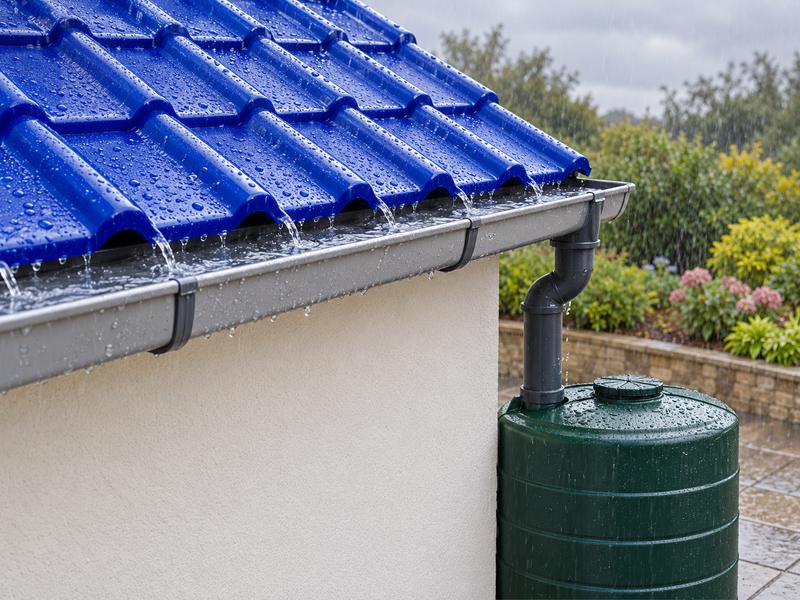
Yes. Resin roof tiles can form the catchment for a rainwater collection system, with gutters carrying runoff into storage. Ornamental gardening and washing nonfood items are practical uses. Drinking water is a different question: a roof that sheds rain does not automatically provide water suitable for drinking.
The useful distinction is between collecting water and controlling its quality. Roof condition, the first runoff, tank design and the intended use all matter. A large tank alone cannot solve those questions.
The roof starts the water’s journey
HESU’s ASA synthetic resin roof tile is a profiled sheet, rather than a set of individual clay tiles. Its ASA surface and PVC-based body provide the roof covering. The covering’s ability to drain rain does not establish drinking-water contact approval.
Water travels down the roof slope, crosses the eave and enters the gutter. From there, the system routes it through debris interception and first-flush diversion before storage. Each junction needs a job: collect flow, separate unwanted material or carry excess water away.
Tile-shaped profiles also influence the eave detail. On a synthetic Spanish roof tile roof, the gutter needs to catch flow leaving the shaped sheet edge. Rainwater that overshoots the gutter never reaches the tank. Gutter and downpipe sizing must handle local rainfall intensity, not just an average monthly rainfall figure.
The first roof wash should not go straight into storage
A dry roof accumulates dust, leaves and sometimes bird droppings. The first rain washes that material toward the gutter. This explains why a clean-looking roof and a clean-looking tank are not enough.

A first-flush diverter sends the initial runoff away from the storage tank. It sits in the collection route between the gutter and tank inlet. The appropriate diverted volume depends on catchment area, debris exposure and the system design. There is no single litre setting that suits every resin roof.
Leaf screens and first-flush diversion solve different problems. A screen catches larger debris; it does not remove every dissolved contaminant or microorganism. A diverter reduces the dirty first wash; it does not make the remaining water drinkable.
The diverter also needs to empty or reset as its design requires. A blocked drain can leave it full, so the next rainfall bypasses its intended function. Keep roof inspection separate from tank maintenance. The resin roofing sheet maintenance guide covers the roof-side checks without replacing the collection equipment’s maintenance instructions.
How much water could a resin roof collect?
Start with the horizontal roof footprint that drains to the connected gutters. Do not use the larger sloped sheet area or the purchased sheet quantity. If only one roof slope connects to the tank, count only that slope’s projected catchment area.
One millimetre of rain falling on one square metre equals one litre of water. That makes the calculation straightforward:
Collected litres = connected roof footprint in m² × rainfall in mm × assumed collection efficiency.
For example, take a 100 m² catchment and a 20 mm rainfall event. The theoretical volume is 2,000 litres. With an illustrative collection efficiency of 80%, the estimated inflow becomes 1,600 litres. The remaining allowance covers losses such as initial diversion, splash and incomplete collection.
That 80% factor is an assumption, not a measured HESU product rating. Actual losses depend on the roof, rainfall and equipment. Do not subtract the same first-flush allowance twice if the efficiency factor already includes it.
Most importantly, estimated inflow is not the amount you can necessarily store. If the tank has only 600 litres of free space, much of that example’s inflow will overflow. Useful storage depends on rainfall timing and water demand between storms, not simply annual rainfall totals.
A full tank must still leave the building well drained
Provide a defined overflow route that carries excess water away from foundations, entrances and vulnerable ground. Connecting a tank should not turn a working roof drainage system into a source of flooding when storage fills.
Keep the tank covered, and use suitable insect-proof screens at its inlet and overflow. Access for cleaning still matters. A tank that hides behind a building but cannot be inspected is a poor maintenance arrangement.
Roof work can temporarily change the water entering storage. Disconnect collection during chemical cleaning, coating work or nearby spraying when residues could reach the roof. Reconnect only after cleaning and flushing appropriate to the substances and system involved.
Decide the water use before specifying treatment
For ornamental planting or washing nonfood items, rainwater collection can put roof runoff to useful work without treating it as drinking water. Keep that supply separate from potable plumbing. Other uses may require additional treatment or local approval.
For drinking, cooking or rinsing food, assess the entire contact path: roof surface, flashings, gutters, pipes and tank. Treatment and testing must address the intended use and local health requirements. NSW Health’s rainwater hygiene guidance explains contamination risks and ways to maintain a collection system.
The practical starting point is therefore a defined use and a connected catchment. Calculate likely inflow, allow for the first roof wash, and preserve safe overflow drainage. Those decisions make a resin roof’s rainwater collection useful; tank size alone does not.