
4-Way Ridge Tile for Four-Hip Roof Apex Junctions
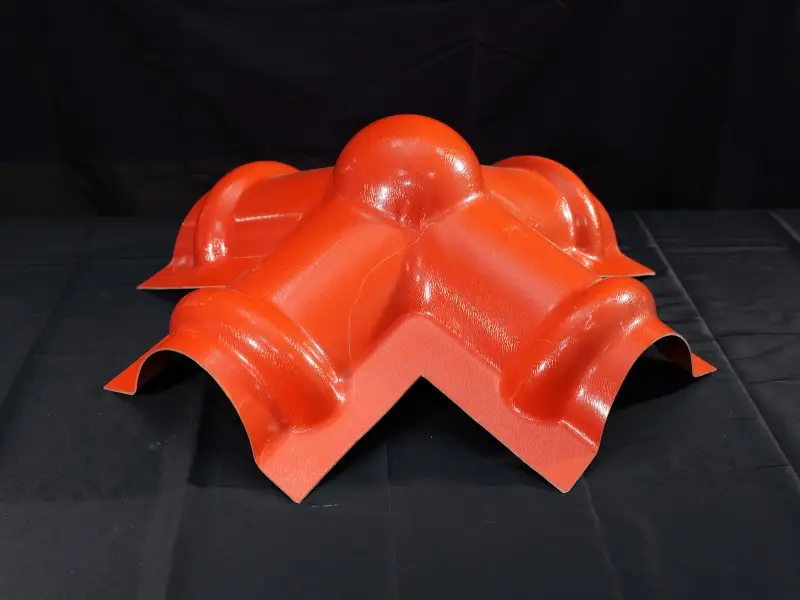
A 4-way ridge tile, also called a four-way roof ridge connector, finishes the central apex where four sloping hip lines meet. The HESU component shown has four molded skirts around a raised center. Each skirt must align with a compatible hip tile run, so roof geometry, profile matching, support, and overlap matter more than visual similarity. The connector is one part of the weather-shedding assembly, not a universal cap.

Karina Su
Call: +86 15306896380
4-Way Ridge Tile Product Identification
The photographed HESU component is a four-direction apex accessory. It belongs at one central point where four hip lines terminate; it does not cover a continuous ridge or the main roof area.
| Identification | HESU 4-way ridge tile | Why it matters |
|---|---|---|
| Common names | 4-way ridge tile / four-way ridge connector | Both names describe a roof-tile apex accessory, not a frame connector. |
| Visible form | Four molded skirts around a raised center | Each skirt continues toward one hip direction. |
| Roof position | Central apex of a four-sided hipped roof | Four hip centerlines must terminate at the same point. |
| Compatibility | Profile-specific hip and ridge accessory | Appearance alone does not confirm fit with another tile system. |
The page image shows an orange-red component. Exact dimensions, material construction, and fixing details remain profile-dependent and should follow the approved drawing and installation guidance for the selected HESU roof tile system.
Which Roof Shapes Need a Four-Way Ridge Connector?
Pyramidal hipped roofs
Four roof planes rise toward one central apex, producing four external hip lines and no continuous horizontal ridge. This is the clearest geometry for a 4-way ridge tile.
Pavilion and square-plan roof sections
A pavilion, compact villa, entrance roof, or isolated square roof section may use the same connector when four hip runs terminate at one apex. The plan must show one four-direction meeting point; architectural symmetry alone is not enough.
When a 4-way connector is not the correct part
A roof with one horizontal ridge meeting two hips normally needs a 3-way roof ridge connector. A continuous peak uses resin roof ridge tiles. Count and trace the roof lines on the drawing before selecting the junction component.
How Four Hip Lines Fit the Apex Connector
Four hip centerlines must converge at one apex
The four roof planes, hip supports, and hip tile runs should arrive consistently. If one line finishes high, low, or off-center, one skirt of the connector may rock or leave uneven contact.
The connector and hip tiles must share profile geometry
Hip-tile curvature, skirt shape, overlap direction, and contact area determine whether the four branches sit naturally. A part with a similar color can still be incompatible with the selected ridge profile.
The completed apex remains visible from every elevation
On a synthetic Spanish roof tile roof, the central apex is visible above all four slopes. Coordinating profile, color, and surface finish helps the hip lines read as one continuous roof system.
Dry-fit the junction before final fastening
Check the four hip runs, apex support, skirt contact, and intended water path before fixing the connector. Do not pull an incompatible part into position with screw pressure. Overlap, hole preparation, fastener type, washer seating, and fixing frequency must follow the selected Spanish roof tile accessory system and its compatible ASA synthetic resin roof tile guidance.
Contact Us
FAQ About 4-Way Ridge Tiles
What is a 4-way ridge tile?
A 4-way ridge tile is a molded roof accessory used at the central apex where four sloping hip lines meet. It has four branches or skirts and should not be confused with a straight ridge cap, a field roofing tile, or a metal frame connector.
Which roof shapes use a four-way ridge connector?
It is used on pyramidal, pavilion, square-plan, and other hipped roof sections where four hip centerlines terminate at one high point. A roof with one main ridge and two hips normally requires a 3-way connector instead.
How is a 4-way ridge tile different from a 3-way connector?
A 4-way ridge tile receives four hip directions at a central apex. A 3-way connector normally joins one main ridge and two hip lines. The components solve different roof junctions and are not interchangeable.
Can one 4-way ridge tile fit any resin roof tile?
No. The connector must match the selected hip tiles and main roof tile system. Branch angle, skirt shape, overlap direction, support position, color, and surface finish can differ even when two accessories look similar.
How should a 4-way roof ridge connector be fitted?
Align and dry-fit the four hip runs before final fixing. Confirm apex support, branch contact, overlaps, fastener and washer requirements, and the water-shedding path using the approved guidance for the selected roof tile profile. Do not pull an incompatible connector into place with screw pressure.