
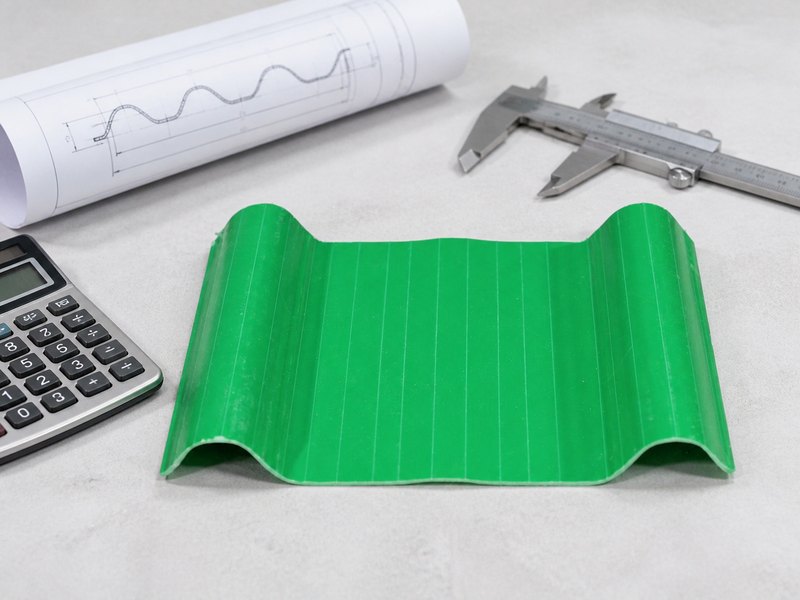
PVC roofing sheet price currently appears at about US$2.50-4.50 per nominal square metre across public China-origin export listings checked on 14 August 2026. This is a practical early-budget range for corrugated PVC-labelled sheets, not a fixed HESU quotation or a delivered project price.
The range covers listings that do not always use the same product definition. Some describe standard PVC. Others include rigid UPVC or an ASA surface layer. A usable comparison therefore keeps four boundaries fixed: product identity, effective covered area, factory scope and delivery scope.
What is a realistic PVC roofing sheet price in 2026?
| Observed market reference | Price or unit | Scope |
|---|---|---|
| China-origin PVC-labelled corrugated sheets | About US$2.50-4.50/m2 | Public export listings; commonly nominal area and minimum-order pricing |
| Quantity-tier listing | US$3.50, US$3.15 and US$2.59/m2 | Price falls across three listed order bands; product title includes ASA+PVC |
| Philippines T1130 retail listing | PHP455/m2 | Local retail; page identifies ASA+PVC or UPVC and a selected specification |
| UK clear 1.1 mm stock sheets | About GBP11.70/m2 of stated effective area, ex VAT | Regional retail stock, not an opaque China factory product |
The US$2.50-4.50/m2 band is the most useful starting point for export planning. It is intentionally narrower than the full global retail market. Local stock, tax, distribution margin and short-piece handling can move retail prices far above a factory listing.
For a broader material comparison, HESU’s guide to roofing sheet types and prices separates plastic, resin, metal and daylighting products. The analysis here stays with corrugated PVC and its immediate product boundaries.
Which product does the price describe?
Standard PVC roofing sheet is a formed plastic roof covering used on agricultural buildings, light-industrial roofs, storage shelters, workshops and canopies. HESU’s PVC roofing sheet range treats profile geometry, effective coverage, thickness, cut length, color and packing as one product definition.
UPVC is not simply another spelling. It normally indicates an unplasticized, more rigid PVC formulation. A solid corrugated UPVC profile and a hollow UPVC panel also consume material in different ways. The UPVC roofing sheet range therefore remains a separate product family.
An ASA-surfaced sheet adds another exposed material layer and a co-extrusion requirement. Its color and weathering purpose differ from standard single-material PVC. A listing that combines PVC, UPVC and ASA+PVC may still provide market context, but it cannot define one exact HESU product price.
Why does effective coverage change the real cost per m2?
Nominal area uses the full sheet width and length. Installed coverage removes the side-lap area and, when present, the end-lap area. The invoice can stay unchanged while the cost per covered square metre rises.
Nominal sheet area = total width x sheet length
Effective covered area = effective width x installed covered length
Sheet cost per effective m2 = sheet price / effective covered area
Consider a 3.0 m sheet with a total width of 1.00 m, an effective width of 0.90 m and a nominal price of US$3.00/m2:
| Calculation | Result |
|---|---|
| Nominal sheet area | 1.00 x 3.00 = 3.00 m2 |
| Sheet value at nominal rate | 3.00 x US$3.00 = US$9.00 |
| Effective covered area without an end lap | 0.90 x 3.00 = 2.70 m2 |
| Material cost per effective covered area | US$9.00 / 2.70 = US$3.33/m2 |
The side lap raises the effective-area cost by about 11% in this example. A required end lap would reduce coverage again. This is why price per sheet, price per nominal square metre and price per effective square metre are different values.

Published product data confirms that the gap can be substantial. One clear PVC profile lists 762 mm overall width and about 700 mm effective width. Another product-specific coverage table lists 762 mm original width and 651 mm covered width. Those figures apply only to their stated profiles. HESU uses the current profile drawing for its own calculation.
How do thickness and formulation affect PVC sheet cost?
Thickness usually increases material mass within one controlled profile. More mass raises the resin-compound input per metre. The relationship is not perfectly proportional because profile geometry, thickness distribution, process stability and production yield also matter.
PVC roofing is made from a compound rather than pure resin alone. The Plastics Europe PVC overview explains that additives can adjust properties such as rigidity, strength, color and transparency. Stabilizers, processing aids, modifiers, pigments and fillers therefore perform different functions. A lower compound cost does not reveal which function changed.
Thickness values are comparable only within the same structure. A 1.5 mm solid corrugated wall and a multi-layer or hollow product do not describe the same cross-section. Overall hollow-panel depth includes cavities and cannot be priced as an equal thickness of solid PVC.
Why do profile, color and cut length move the quotation?
The profile tool determines wave or rib geometry, edge shape and effective width. Deeper or wider profiles distribute material differently. Two sheets with the same total width can have different mass per linear metre and different installed coverage.
Color affects pigment preparation, production sequencing and line cleaning. A standard production color can fit an established run. A special color or small isolated batch can create more setup work without changing the roof area.
Cut length affects more than the number of metres. Longer sheets may remove end laps, yet they require suitable factory handling, stack support, loading space and site lifting. A long profile that deforms during transport has no cost advantage.
How do production quantity and packing affect the factory value?
Every run includes compound preparation, color setup, profile tooling, temperature stabilization, cutting and inspection. A short run spreads these operations across fewer finished metres. A longer run can use the line more continuously when the profile, color and length schedule remain stable.
Packing protects the profile created on the extrusion line. Corrugated sheets need level support and controlled strapping so crests and edges do not carry concentrated pressure. Bundle labels must keep lengths, colors and accessories identifiable after loading.
These operations explain quantity effects without promising one universal discount. The actual step depends on the production schedule, specification, packing method and order size.
Which costs sit beyond the bare PVC sheet?
A roof uses more than sheets. It also uses compatible screws, broad sealing washers, ridge or edge pieces, wall flashings, closures, spare material and suitable packing. Installation adds lifting, cutting, drilling, alignment and weatherproof junction work.
Profiled plastics work as part of a complete roof assembly. Fasteners, support spacing, loading, temperature change and junction details remain system concerns. This is why the sheet value cannot represent the complete roof.
| Cost layer | Typical contents | Useful unit |
|---|---|---|
| Sheet value | Defined PVC profile, thickness, color and cut length | Per sheet, linear metre or nominal m2 |
| Covered-area value | Sheet value divided by effective installed area | Per effective m2 |
| Roof-material package | Sheets, accessories, fasteners, washers, spares and packing | Per roof area or complete material schedule |
| Delivered material | Product package plus stated transport and trade-term scope | Total at a named place and date |
| Installed roof | Delivered material plus labor, lifting, cutting, access and site details | Project-specific installed total |
How do freight and trade terms change the final number?
Ex-factory, FOB, CIF and delivered prices do not contain the same work or risk. A valid comparison names the trade term, location, currency and quotation date. Freight can change while the sheet specification remains identical.
Sheet length and nesting affect container use. Long profiles may leave unusable space or require a different container plan. Accessories can use a separate packing volume. Destination charges, import duties, tax and local delivery remain outside a China-origin product reference unless the quotation states otherwise.
The US$2.50-4.50/m2 range at the start of this article is therefore a product-market reference. It is not a landed or installed rate.
What information defines a current HESU PVC quotation?
| Field | Required definition |
|---|---|
| Product identity | Standard PVC, UPVC or ASA-surfaced construction |
| Profile | Profile code or drawing, wave geometry and lap edge |
| Dimensions | Total width, effective width, thickness and cut length |
| Area basis | Per sheet, linear metre, nominal m2 or effective m2 |
| Production | Color, quantity, length schedule and applicable inspection scope |
| Accessories | Listed fasteners, washers, ridge pieces, flashings and spares |
| Packing | Bundle, labels, support and container arrangement |
| Delivery | Currency, quotation date, trade term and named place |
With these fields fixed, HESU can calculate a current product value and convert it to effective covered area. Without them, a single price may describe a different material, width, quantity or delivery boundary.
PVC roofing sheet price FAQ
How much is PVC roofing sheet per square metre?
Public China-origin listings checked on 14 August 2026 support a preliminary range of about US$2.50-4.50 per nominal m2. The current HESU value depends on the exact product, profile, thickness, color, quantity, packing and delivery term.
Why is the price per effective m2 higher than the listed rate?
Side and end overlaps reduce the roof area covered by each physical sheet. Dividing the same sheet value by a smaller effective area raises the covered-area rate.
Does a thicker PVC roofing sheet cost more?
Within one controlled solid profile, greater thickness normally adds material mass and cost. Across different profiles, hollow structures or surface-layer systems, thickness numbers are not directly comparable.
Is UPVC roofing sheet the same price as PVC?
No universal relationship applies. UPVC uses a more rigid formulation, and UPVC products can be solid, hollow or surfaced. Their material mass, profile, production process and application differ from standard PVC.
Does the price include screws and ridge pieces?
Only when the quotation lists them. Sheets, fasteners, washers, ridge pieces, flashings, spares, packing and freight need separate scope lines.
How often should the reference range be updated?
Review it when resin inputs, exchange rates, freight or public listing patterns change. A dated range should not remain online indefinitely without a fresh evidence check.
Technical conclusion: use US$2.50-4.50/m2 as a 14 August 2026 preliminary export reference for PVC-labelled corrugated roofing sheets. Then fix the product identity and divide by effective covered area. Add production, accessories, packing and delivery as separate cost layers. That sequence turns a market number into a usable roof-material budget.