
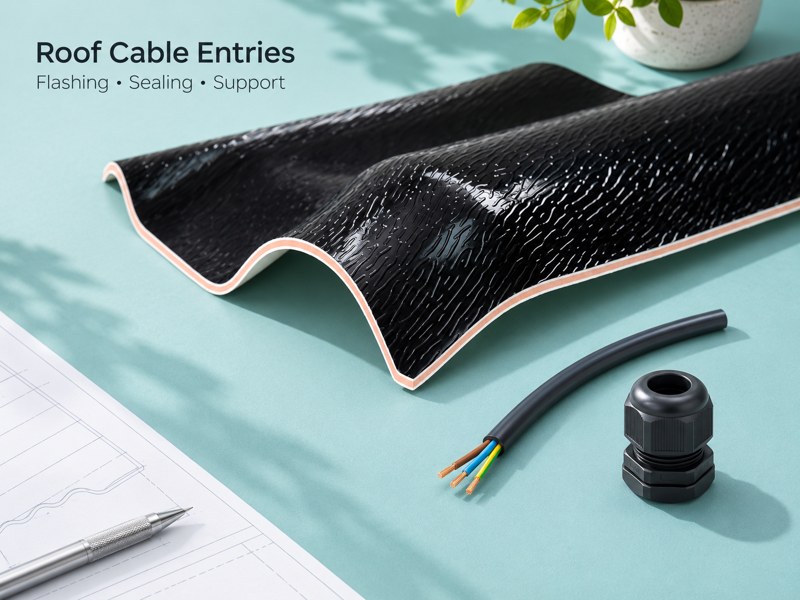
A cable penetration through a resin roof needs a profile-compatible flashing, a correctly sized cable seal and independent cable support. Drilling a hole and filling it with silicone leaves too much work to one small joint. The roof must shed rain, while the entry assembly protects the cable without restraining normal sheet movement.
The first design question is whether the cable needs to cross the roof at all. A suitable wall entry may avoid a roof opening. Where a rooftop entry is necessary, resolve the complete route before cutting the sheet. This applies to lighting, ventilation equipment and solar installations, although each electrical system has different requirements.
Choose the route before the hole
The shortest cable route is not always the easiest route to waterproof. A proposed entry may sit beside a sheet lap, within a runoff channel or behind equipment that blocks inspection. Moving the entry during planning is simpler than rebuilding a poor junction after installation.
Compare the roof route with a wall or gable route. A wall entry still needs proper weatherproofing and cable protection. An eave route must not pinch a cable between overlapping sheets or leave it rubbing against an edge. Avoid creating a new problem simply to avoid a roof hole.
On a roof, locate the entry where the selected flashing system can fit the actual profile and slope. Keep concentrated runoff from valleys and other roof junctions in mind. Do not choose a crest solely because it looks drier; the complete fitting must seat and drain as its manufacturer intends.
Three interfaces, three different jobs
A cable gland seals around a cable. Roof flashing manages water around the opening. Supports carry the cable or conduit. One component may combine functions, but the design still has to satisfy all three.
| Interface | What it must do | What does not prove it works |
|---|---|---|
| Flashing to roofing | Fit the profile and direct runoff around the opening | A neat ring of exposed sealant |
| Cable to entry seal | Seal the intended cable diameter and arrangement | A weatherproof gland fitted around the wrong cable size |
| Cable or conduit to support | Control weight and movement without loading the roof seal | A tight gland holding a long unsupported run |
An enclosure’s weather-resistance rating does not establish that its base will seal to a curved roof sheet. Likewise, a well-formed flashing does not make an unsuitable cable appropriate for outdoor electrical service. Treat the roof junction and the electrical installation as connected but distinct systems.
Resin roof cable entries must fit the sheet profile
A continuous profiled sheet does not behave like separate clay tiles. A cable cannot simply pass beneath one lifted tile if that shape forms part of a larger sheet. For an ASA synthetic resin roof tile, the entry detail must account for the continuous sheet and its raised, stepped surface.
A flashing base may cross a crest, slope and channel. If it bridges these shapes rather than fitting them, gaps can remain beneath an apparently tidy perimeter. A flexible base must suit the actual surface and installation method, not merely carry a label saying it fits tile roofs.

Match any sealant, tape or gasket to the exposed resin surface and the fitting material. Follow the roofing and fitting manufacturers’ compatibility requirements. Do not assume a sealant intended for metal roofing will adhere reliably to every plastic formulation.
A PVC roofing sheet also needs a detail for its own profile. Similar colours or wave heights do not establish that two roofing products accept the same flashing.
Where the roof includes underlayment, maintain its drainage around the penetration as well as the outer covering. General roof-flashing guidance often shows decked shingle assemblies. Those drawings explain water-control principles; they are not ready-made fixing details for resin sheets installed over purlins.
Let supports carry the run, not the seal
Support cables and conduit so their weight does not pull on the entry assembly. Keep the route away from sharp edges, hot equipment and surfaces that can abrade the insulation. Use supports suitable for the exposure and the particular electrical installation.
Allow the required cable bend radius. A forced bend immediately at a gland can load the seal and damage the cable. A large loose loop is not automatically better: it can catch debris or move against the roof. The route needs controlled movement, not random slack.
For solar work, cable-support selection also needs to address heat and ultraviolet exposure. The U.S. Department of Energy’s cable-management guidance identifies premature support failure as a risk to insulation and system performance. A generic indoor tie is not a substitute for a specified outdoor support.
The cable itself remains a separate specification. XWA Energia presents electrical cables for energy and infrastructure applications. Its cable information can inform that side of a project, but it does not establish compatibility with a HESU roof penetration.
Inspect both sides of the completed entry
At handover, check the outside water path and the inside cable route together. Look for gaps beneath the flashing, obstructed drainage, crushed sheet surfaces, sharp contact points and tension at the gland. Photograph accessible junctions before equipment hides them.
A controlled water check can help identify a leak path after the installer completes the junction. Follow the system’s procedure rather than forcing a high-pressure jet uphill into laps. A dry result on one day does not remove the need for later inspection.
If moisture appears inside, establish whether it comes from the roof junction, condensation or another route. Water can travel before it becomes visible. Do not cover every nearby surface with more sealant before identifying the source.
Electrical isolation, wiring and electrical checks belong to qualified personnel under the applicable local rules. Roof access also needs a planned safe method; a resin sheet is not a walking platform.
Keep the entry serviceable after equipment arrives
Leave access to the gland, flashing perimeter and nearby drainage. Future cable replacement should not require breaking a bonded roof joint unless the approved assembly specifically requires that work. Unused openings need suitable permanent closure, not a temporary plug left in place indefinitely.
Solar projects add a related structural task. The guidance on solar panels on resin roof tiles addresses how the array transfers loads into the frame. Cable entry design addresses a narrower issue: crossing the weather layer without damaging the roof or wiring.
The useful result is a junction that remains understandable when someone returns to service it. Water has a clear route outside, the cable has a protected route inside, and neither route depends on the other carrying an unintended load.