
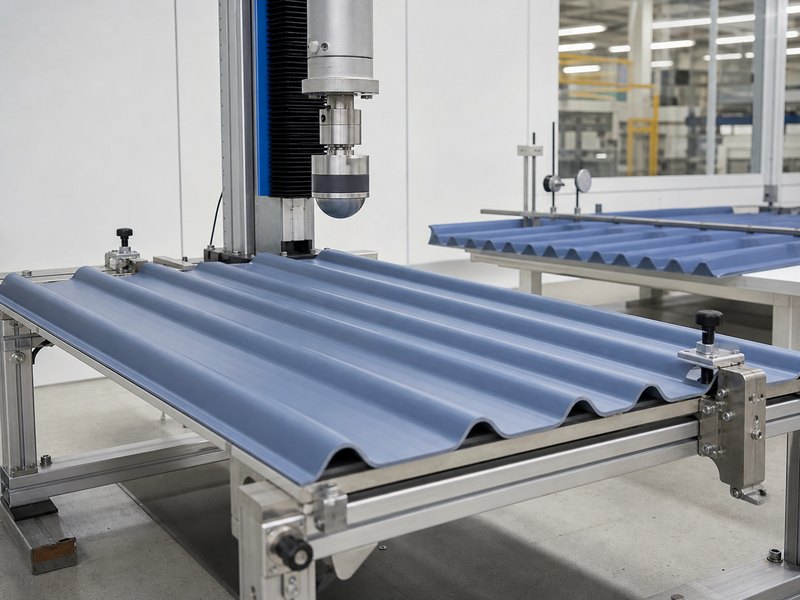
Plastic roofing sheet impact testing measures a product response under one defined combination of specimen, support, impactor, environment, and failure rule. The result does not describe every hailstone, falling object, temperature, profile, or installed roof. It describes the test that produced it.
This distinction matters because the phrase impact resistant can refer to a threshold pass, a failure energy, a force-displacement curve, an assembly classification, or resistance to a broad falling load. Those outputs answer different questions. A reliable statement keeps the complete test fingerprint attached.
What must accompany a plastic roofing sheet impact result?
| Fingerprint item | Question it answers | Why it changes the result |
|---|---|---|
| Product form | Flat coupon, cut profile, full sheet, or installed assembly? | Curvature, joints, fasteners, and unsupported areas change load paths. |
| Conditioning | What thickness, temperature, moisture, age, and processing history applied? | Rigid plastics respond differently as material state and impact rate change. |
| Support | Was the specimen clamped, laid on a plate, or fixed across purlins? | Support controls bending length and whether the striker causes flexure or local shear. |
| Impactor | What mass, shape, material, speed, and target location applied? | A rounded dart, steel ball, ice sphere, and sandbag distribute force differently. |
| Output | Pass/fail, failure energy, peak force, displacement, absorbed energy, or classification? | One number cannot substitute for another measurement. |
| Failure rule | Did failure mean a crack, hole, split, joint opening, or loss of function? | A dent or whitening mark may not equal puncture, while a fine crack can still matter. |
Impact energy is only one part of this fingerprint. Two events can carry similar nominal energy yet produce different stress because their speed, mass, contact radius, support, and impact duration differ. A result without these boundaries is difficult to interpret and unsafe to generalize.

Why do impact-test methods answer different questions?
Non-instrumented falling-dart methods can estimate a threshold at which a group of flat specimens begins to fail. ISO 6603-1 uses repeated specimens and statistical procedures for that purpose. It does not turn one dramatic drop into a complete material rating.
Instrumented methods add sensors. ISO 6603-2 records force with deflection or time, while ASTM D3763 records load and displacement during high-speed puncture. These curves reveal peak force, deformation, energy absorption, and post-peak behavior. ASTM also states that its method differs technically from ISO 6603-2, so the results should not be compared as if they came from one procedure.
ASTM D5420 uses falling-weight geometries to rank flat rigid-plastic specimens by cracking or breaking response. Its striker and support geometry can alter the failure mode. A close support opening may encourage local punch shear, while a wider opening permits more bending.
ASTM D4226 narrows the subject to rigid PVC building products, including sheet and profile flat sections. This scope is relevant to a PVC roofing sheet, but a flat section still does not reproduce every crest, pan, lap, fastener, and span in a finished roof.
Roofing-oriented standards move toward products and assemblies. AS/NZS 4257.6 addresses plastic building sheets. UL 2218 targets vulnerable locations in prepared roof-covering assemblies. AS/NZS 4040.4 simulates the broad load of a person falling onto a plastic sheet incorporated into a roof. A hard striker, a steel ball, and a sandbag therefore cannot share one interpretation.
How does the roofing profile change impact behavior?
A flat coupon removes most profile geometry. A corrugated sheet keeps raised crests and lower pans. A tile-effect sheet adds longitudinal waves plus transverse steps. Each section distributes impact into a different mix of local indentation, membrane stretch, bending, and support reaction.
An impact on a crest begins at a curved, elevated region. The crest may spread load toward neighboring pans, but it can also flatten locally. An impact in a pan acts closer to the drainage surface and may have a different unsupported width. A side lap adds double thickness but also introduces an edge and possible movement between sheets.
Support location is equally important. A strike directly above a purlin has a short bending path. The same strike at midspan can deflect a larger sheet area. Fastener zones add holes, washer pressure, and local restraint. Results from one location should not be silently assigned to the others.
The same geometry principle applies to an UPVC roofing sheet. Rigid formulation and profile depth work together, but neither term defines impact response alone. Thickness distribution across the crest, sidewall, pan, and edge also needs control.
Why do thickness and temperature need their own record?
Rigid plastics are rate- and temperature-sensitive materials. Their balance between elastic deformation, yielding, whitening, and cracking can shift when temperature or impact velocity changes. A warm specimen and a cold specimen may not follow the same failure path.
Thickness also changes response, but not always in a simple linear ratio. Instrumented standards therefore restrict comparisons to equivalent thickness unless a material-specific relationship has been established. Nominal sheet thickness is not enough when a formed profile varies across its section.
Conditioning should identify temperature, moisture state where relevant, specimen age, storage, and preparation. Weathered material belongs in a separate test series from new material. UL 2218 explicitly excludes weathering, temperature, and aging from its impact result, which prevents its classification from becoming a universal field prediction.
Thermal history begins before the test. Uneven cooling can leave residual stress in an extruded and formed sheet. Tight stacking under heat can change profile shape. The HESU discussion of plastic roofing heat deformation shows why temperature, support, and restrained movement need their own evidence rather than being folded into one impact label.
What counts as failure after impact?
Failure needs a written definition before the first specimen is tested. A method may count a visible crack, hole, split, shatter, or tear. Another may use a force drop, complete puncture, or an assembly classification. The result changes when the rule changes.
Visual inspection can separate several conditions. Elastic deflection recovers after the load leaves. Permanent deformation remains. Stress whitening indicates localized plastic deformation. A surface crack may stop within one layer, while a through crack can interrupt water control. A side-lap opening can create a roof-system problem without puncturing either sheet.
Microscopic cracks require a defined inspection method if they form part of acceptance. Light angle, magnification, penetrant, or water checks cannot be added after testing merely to change the outcome. The report needs the same inspection rule for every specimen.
Repeated impact is another separate question. A specimen that survives one event may accumulate damage under several strikes at the same location. Single-impact results should remain single-impact results unless the method defines a sequence.
Which factory variables influence a representative specimen?
Impact behavior starts with formulation consistency. Resin grade, stabilizers, modifiers, fillers, pigments, recycled-content controls, and layer bonding can change local response. A test sample needs batch identity so the result can be traced to the material that produced it.
Extrusion controls layer distribution and total thickness. Forming controls rib height, wave center, pan width, and edge shape. Cooling controls dimensional stability and residual stress. A sample cut only from the thickest flat area may not represent a thin sidewall or a highly formed crest.
Sampling should therefore identify sheet position, profile location, extrusion direction, surface orientation, and distance from an edge. Flat-specimen standards may require machining a finished product, but machining also removes the original curved geometry. The report should state that transformation.
Production images can verify that a real profile and forming process exist. They cannot prove a test result. Test evidence needs the specimen record, method, equipment status, conditions, raw observations, failure classification, and responsible laboratory record.
How should a result move from laboratory to roof system?
A material test characterizes controlled specimen behavior. A product test adds the sheet section. An assembly test adds laps, fasteners, supports, and vulnerable locations. A roof design adds span, slope, wind, maintenance access, temperature, aging, and junctions. These levels support each other, but they are not interchangeable.
ISO 6603 warns that flat-specimen results do not directly predict finished-product impact behavior. UL 2218 also limits direct hail correlation and excludes several field variables. These are not minor disclaimers. They define the correct boundary of the result.
Impact data should not replace structural load tables, installation instructions, walking-safety rules, or local requirements. A sheet can resist a small hard-body impact yet remain unsafe to walk on. A broad person-fall test can address roof safety without describing hail puncture.
The strongest technical record therefore combines layers of evidence. Material data explains formulation response. Profile testing explains geometry. Assembly testing checks weak locations. Installation and inspection preserve the conditions assumed by the roof system.
What should an impact-test report contain?
| Report section | Minimum useful record |
|---|---|
| Identity | Material, formulation or batch reference, product profile, color, layers, and manufacturing date where verified |
| Specimen | Thickness map, dimensions, cut location, orientation, surface condition, and quantity |
| Conditioning | Temperature, moisture condition, aging state, storage, and conditioning duration |
| Method | Full standard designation and edition, plus any permitted deviation |
| Fixture | Support opening, clamping, purlin arrangement, fasteners, and target location |
| Impactor | Mass, shape, material, velocity or drop height, and number of strikes |
| Output | Threshold, energy, force, displacement, curve, damage class, or pass/fail result |
| Failure rule | Defined crack, puncture, split, deformation, joint, or functional criterion |
| Limits | Conditions and product forms to which the result does not apply |
This record makes comparison possible without pretending that all impact tests are equivalent. It also exposes missing information immediately. A bare value with no method, thickness, temperature, or failure rule remains a claim, not a reproducible technical result.
Frequently asked questions
Does a higher impact-energy number always mean a better roof sheet?
No. Energy values are comparable only when method, specimen, thickness, conditioning, support, striker, velocity, and failure rule are equivalent. A different fixture or impactor can create a different failure mechanism.
Can a flat sample represent a corrugated roofing sheet?
It can characterize material taken from the sheet under controlled conditions. It cannot reproduce the full profile, purlin span, side lap, fasteners, or vulnerable roof locations. Product and assembly evidence answer those additional questions.
Is a hail-impact rating the same as resistance to a falling person?
No. Hail and steel-ball methods use concentrated hard-body impact. A sandbag person-fall method applies a broad soft-body load to an installed sheet. Their purposes, stress distribution, and acceptance rules differ.
Why should testing include more than one specimen?
Plastic-sheet response varies with local thickness, processing history, location, and material scatter. Statistical threshold methods use repeated specimens because one pass or one failure cannot define a reliable transition.
Technical conclusion: impact resistance becomes useful evidence only when the result carries its full fingerprint. For plastic roofing sheets, that fingerprint must preserve material, profile, condition, support, impactor, output, and failure boundaries from the laboratory record to the final technical statement.