
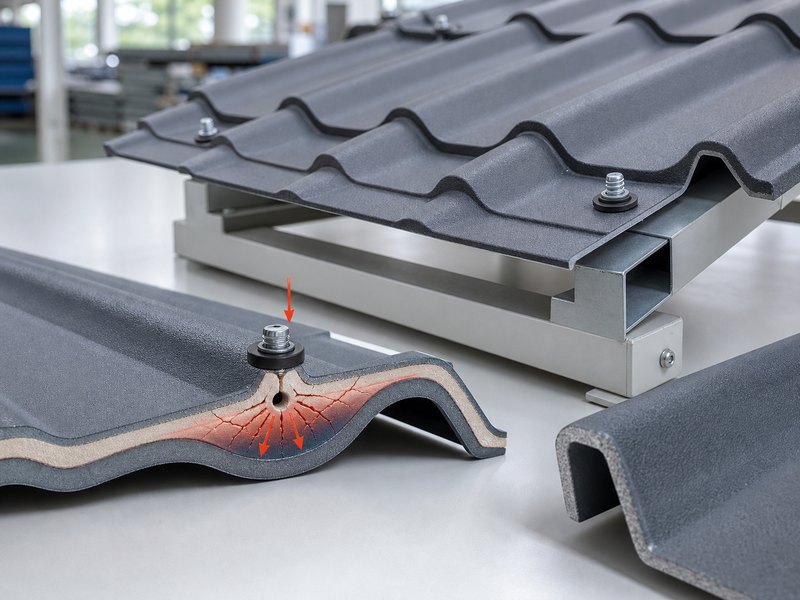
Synthetic resin roof tiles crack when stress collects in one weak place. The visible line may appear near a screw hole, cut edge, chevaucher, ridge area, or unsupported span. The real cause often starts earlier, in layer bonding, stabilité de l'extrusion, handling, espacement des supports, or heat movement.
HESU does not treat cracking as a simple material-name problem. A resin tile works as part of a roof system. Its ASA surface, body layer, profile shape, fixing pattern, and support structure must share load and movement. When one part carries too much stress, the crack usually shows there first.
What does a crack location reveal?
The first useful clue is location. A crack that begins at a screw hole points toward fixing stress, washer pressure, or movement restriction. A crack along a cut edge often points toward rough cutting, drilling heat, or impact during handling. A crack across the tile wave may point toward wide purlin spacing, repeated flexing, or foot pressure on an unsupported area.
Crack shape matters too. A short star-shaped mark near a fastener shows concentrated pressure. A long straight crack along the length can suggest stress from bending or storage. A brittle broken corner usually starts with impact, poor stacking, or a sharp edge hit during loading. HESU reads these signs before blaming the material alone.

How does layer structure affect cracking?
A synthetic resin roof tile is not only a colored sheet. In an Tuile en résine synthétique ASA, the outer ASA layer protects the exposed surface from weather and color aging. The body layer gives the tile its shape and mechanical support. The two layers must bond well during extrusion.
Uneven thickness can create hidden stress. A thin area bends more than the surrounding surface. A thick area may cool and shrink differently during production. If the layer bond is weak, heat cycles can turn that mismatch into a crack path. Stable extrusion matters because it keeps the tile profile, épaisseur, and layer contact consistent.
Material formulation also matters. Resin and PVC systems need suitable stabilizers, fillers, and processing control. Too much brittle filler can reduce impact tolerance. Poor mixing can leave hard or weak spots in the body layer. The issue may not appear during visual inspection, but roof movement can expose it later.
Why do screw holes become weak points?
A screw hole is a planned opening in the tile. It can stay safe when the hole, washer, screw angle, and support line match. It becomes risky when the fixing point squeezes the tile too tightly or blocks normal expansion.
Over-tightening can crush the wave around the washer. It can also create a stressed ring around the hole. Under sun exposure, the tile expands. At night, it contracts. If the screw locks the tile in place, movement concentrates at the hole. The stress then has only one place to go.
The installation logic is similar to the movement rules in HESU’s Guide d'installation des tôles de toiture en PVC. Correct fixing gives the roof enough seal pressure and enough movement room. A neat screw line is not enough if the washer pressure, pre-drilled hole, and purlin position do not work together.
How do support spacing and roof movement cause cracks?
Every tile profile needs support. When purlins sit too far apart, the tile flexes between supports. This flexing may look small, but wind, pluie, and roof vibration can repeat it many times. Repeated movement can open a crack near an overlap, screw hole, or high-stress corner.
Foot pressure creates another risk. A resin tile can handle normal roof loading only when force transfers through the supported part of the profile. Stepping between purlins bends the wave shape. That action can start a fine crack that grows after heat cycles and rain exposure.
Roof geometry also changes stress. Vallées, crêtes, jonctions murales, and curved roof areas can push the tile into awkward positions. If a tile must twist to fit a roof detail, the profile stores stress. HESU prefers clean alignment, suitable accessory pieces, and stable support because they reduce forced bending.
Can handling and cutting start cracks before installation?
Many cracks begin before the tile reaches the roof. Long tiles need stable stacking and careful lifting. A corner that hits the ground can develop a small fracture. The fracture may stay invisible until the roof heats up or the tile bends during fixing.
Cutting and drilling need the same care. A dull blade can chip the edge. A hot drill can roughen the hole. Fine cracks around the cut can later connect with screw stress or thermal movement. Clean cutting, smooth holes, and dust removal help protect the edge from becoming the first crack line.
Storage conditions also matter. Tiles should not sit on uneven ground where the stack bends. Tight strapping can mark edges when the load shifts. Long exposure before installation can heat the top layer while the lower layers stay cooler. That temperature difference can add stress to a poorly supported stack.
How are weathering and cracking different?
Weathering changes the surface. Cracking breaks the structure. The two can appear together, but they are not the same problem. UV exposure may dull a weak surface layer, while structural cracking usually needs stress from fixing, bending, impact, or thermal movement.
This distinction matters for tuile en plastique evaluation. A faded surface does not always mean the tile will crack. A bright surface does not always mean the roof detail is safe. HESU looks at surface condition, profile shape, screw holes, overlap areas, and support lines together.
What is HESU’s factory view on crack prevention?
Crack prevention starts with stable production. Layer thickness, extrusion temperature, cooling control, color consistency, and packing pressure all affect the tile before installation begins. Factory control cannot remove every roof-site risk, but it reduces hidden stress in the product.
Installation then decides whether that stable product stays stable. The tile needs suitable slope, enough support, clean holes, controlled washer pressure, and room for heat movement. Crête, eave, and side accessories must fit the profile instead of forcing the tile into position.
The practical rule is simple: do not let material stress, fixing stress, and handling stress meet at the same point. A crack rarely comes from one detail alone. It usually grows where several small stresses overlap. HESU’s technical focus is to keep those stresses separated through product structure, manufacturing control, emballage, and roof-system detailing.