
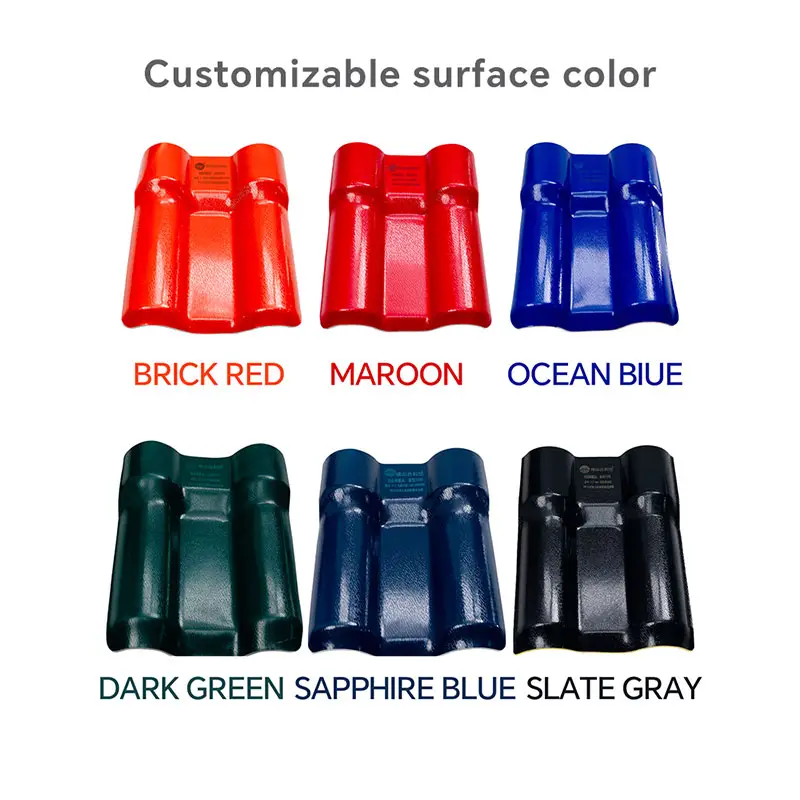
Tuile de toit en plastique


Karina Su
Walk through any building materials market and you’ll find plastic roof tiles sold under a dozen different names — synthetic resin tile, ASA composite tile, PVC roof panel, polymer roofing sheet. They’re all variations on the same concept: a lightweight, low-maintenance alternative to clay, concrete, or metal roofing that performs better in harsh conditions than most traditional materials.
The category has grown fast. In China, Southeast Asia, and emerging markets across Africa and Latin America, plastic roof tile has gone from a budget substitute to a mainstream specification choice. The shift is driven by practical factors — weight, cost, corrosion resistance — not aesthetics.
What Plastic Roof Tile Actually Is

ASA Composite Roof Tile
ASA (Acrylonitrile Styrene Acrylate) composite tile uses a PVC base with a co-extruded ASA surface layer. The ASA layer blocks 99% of UV radiation and resists acid, alkali, and salt corrosion. It bonds permanently to the base material during manufacturing — it doesn't peel or delaminate.
This is the highest-performing type in the plastic roof tile category. Service life runs 20–30 years in moderate climates. In high-UV environments — Southeast Asia, le Moyen-Orient, Australia — it significantly outlasts standard PVC. Colour retention holds for 10+ years with minimal fading.

PVC Resin Roof Tile
Standard PVC roof tile is a single-layer product. No dedicated UV-protective surface layer. Manufacturing costs are lower. Upfront price is lower.
The tradeoff is durability. Under sustained UV exposure, PVC oxidises. In high-sun climates, surface degradation appears within three to five years. In moderate climates, service life runs 10–15 years. For short-cycle projects or temporary structures, this is acceptable. For permanent buildings, the replacement cost usually exceeds the original price saving.

Polycarbonate (PC) Roof Tile
Polycarbonate tile is the transparent or translucent option. Light transmittance runs 80–90%, which makes it the standard choice for greenhouse roofing, covered walkways, factory daylighting strips, and carport canopies where natural light is a functional requirement.
Impact resistance is approximately 15 times higher than glass. It handles hailstones and windborne debris without shattering. UV-coated versions hold performance for 10+ années. Non-coated versions degrade faster under direct sun exposure — always confirm UV coating before specifying.
Contactez-nous
FAQ of Plastic Roof Tile
How long do plastic roof tiles last?
It depends entirely on the type and grade. Budget PVC tile in high-UV climates degrades within 3–5 years. Mid-grade PVC achieves 10–15 years in moderate conditions. Quality ASA composite tile achieves 20–30 years across a wide range of climates. The material label alone doesn’t determine lifespan — the specification behind it does.
Are plastic roof tiles suitable for cold climates?
Yes — and they handle freeze-thaw cycling better than clay tile. Plastic roof tile is non-porous, so moisture doesn’t infiltrate hairline fractures and expand on freezing. Quality products are impact-tested to resist hailstones up to 3cm in diameter. Load-bearing capacity on good products reaches 150 kg/sqm, which covers significant snow loads.
What is the difference between ASA and PVC plastic roof tile?
PVC tile is a single-layer product with no dedicated UV protection. It fades and degrades under sustained sun exposure. ASA composite tile adds a co-extruded ASA surface layer that blocks 99% du rayonnement UV. The ASA layer bonds permanently during manufacturing — it doesn’t peel. Service life is roughly double that of standard PVC, at a 20–50% price premium.
Can plastic roof tiles handle heavy rain and wind?
Quality plastic roof tile is tested to withstand hailstones up to 3cm diameter and wind loads equivalent to storm conditions. The interlocking profile creates a watertight seal. In typhoon-exposed regions of Southeast Asia and coastal areas with high wind loads, ASA composite tile is a standard specification choice.
