
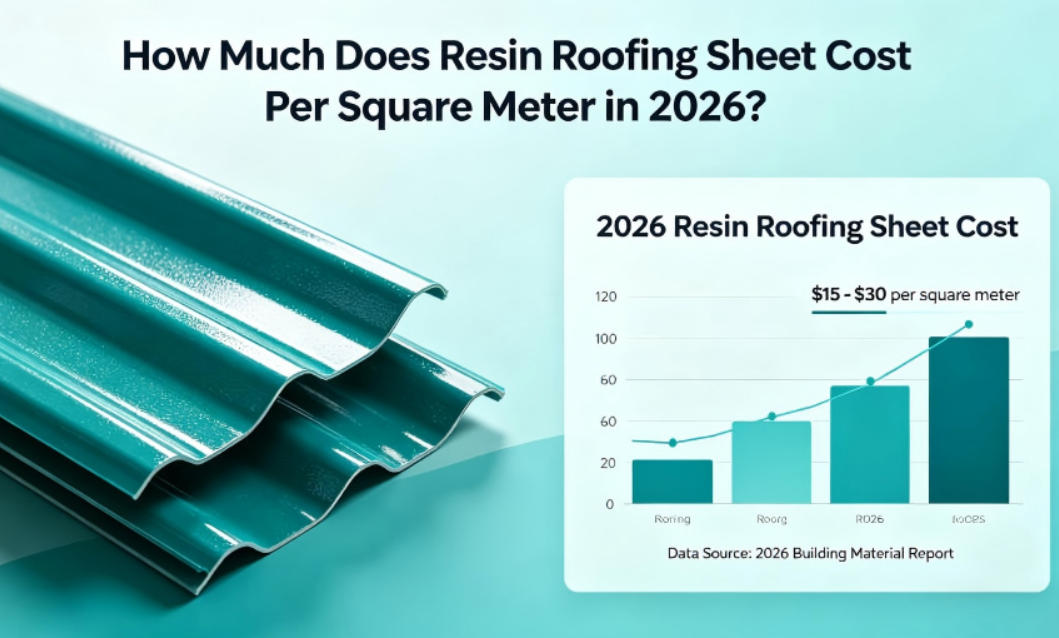
Price is usually the first question, and it’s also the one with the most misleading answers. Ask three suppliers for a quote on resin roofing sheets and you might get numbers that are 300% apart — all technically correct, all for products that perform very differently over time.
The China market in 2026 runs from roughly ¥25/sqm for the cheapest synthetic resin tile to ¥500/sqm for industrial-grade fire-resistant and anti-corrosion panels. That’s not really one product category — it’s five, each solving a different problem at a different price point. Below is an honest breakdown of what each tier actually gets you.
Material-Only Pricing by Product Grade
These are factory prices for material only, without installation, accessoires, or transport:
| Product Type | Price (CNY/sqm) | USD Approx | What You’re Actually Buying |
|---|---|---|---|
| Budget synthetic resin | ¥25–45 | ~$3.5–6.3 | 2.0–2.5mm thickness, minimal UV protection, suitable for temporary or short-term structures |
| Standard synthetic resin | ¥45–80 | ~$6.3–11.1 | 2.5–3.0mm, covers most residential and light commercial requirements |
| ASA/UPVC composite | ¥80–150 | ~$11.1–20.8 | Proper ASA surface coating, meaningfully better UV and weather resistance, 10+ year realistic lifespan |
| Premium APVC / PC | ¥150–500 | ~$20.8–69.4 | Anti-corrosion, fire-rated, industrial and high-specification applications |
For most residential projects — family homes, abris d'auto, farm buildings — the standard synthetic resin tier (¥45–80/sqm) covers the functional requirements at a reasonable cost. The step up to ASA composite becomes worth it when you need colour retention over a decade, resistance to high UV exposure, or the roof is difficult to access for future maintenance.
The budget tier is worth being direct about: ¥25–45/sqm buys you a roof that works for 3 à 5 years in normal conditions. For a permanent structure, that’s not a saving — it’s a deferred replacement cost.
Full Installation Package Pricing
Most project owners work with a local contractor on a supply-and-install basis. This covers materials, fixing hardware, ridge and edge accessories, waterproofing treatment, and basic post-installation inspection.
¥60–100/sqm — Simple structures: temporary sheds, agricultural storage, basic farm buildings. Straightforward roof geometry, no special requirements.
¥100–160/sqm — Standard residential and light commercial: single-family homes, bâtiments communautaires, small commercial units. The range most homeowners will land in.
¥160–200+/sqm — High-specification projects: luxury villas, chemical plant roofing, public buildings with fire code requirements, complex roof geometry. The upper end of this range applies when the roof design involves multiple slopes, lucarnes, unusual angles, or materials that require specialist handling.
Complex geometry typically adds 10–20% to whatever base rate you’re quoted. If your roof has more than two slopes or incorporates skylights, factor that in from the start rather than treating it as a surprise in the final invoice.
Why Quotes Vary — And When to Be Suspicious
Three factors consistently push prices outside the ranges above in 2026:
Raw material costs are less stable than they used to be. PVC et Résine ASA prices have seen meaningful quarterly swings this year as global supply chains continue adjusting post-pandemic. A quote from six months ago may no longer reflect current production costs — 5 à 10% variance between quarters is realistic.
The quality gap is widening. The market is consolidating. Smaller manufacturers producing low-grade product are exiting, which has pushed budget-tier prices slightly lower. Simultaneously, demand for high-performance panels has pushed premium product prices up 8–12% year over year. The middle of the market is increasingly where the best value sits.
Location adds cost. Coastal provinces near manufacturing clusters — Guangdong, Zhejiang, Jiangsu — tend to have the most competitive pricing. Remote inland regions can run 5–15% higher once transport is factored in. This is worth accounting for if you’re comparing quotes from suppliers in different regions.
One practical note: if a quote comes in significantly below the ranges above for the product type you’ve specified, it’s worth asking which spec has been adjusted to get there. Thickness and ASA layer quality are the two easiest places to cut costs invisibly.
FAQ
What does a basic resin roofing sheet cost per sqm in 2026? Budget-grade synthetic resin starts at ¥25–45/sqm for material only. Full installation for simple structures starts around ¥60/sqm. These are functional for temporary buildings — for anything permanent, le 3 to 5-year replacement cycle makes them more expensive than they appear upfront.
What’s the price of ASA composite resin roofing sheet? ASA/PVC composite runs ¥80–150/sqm for material. The ASA surface layer is what gives these sheets their UV stability and colour retention over 10+ années. It’s the minimum grade worth specifying for any permanent residential or commercial roof that will be difficult to replace.
What does full installation cost per sqm? ¥60–200+/sqm depending on project type. Most standard residential projects land in the ¥100–160/sqm range including materials, fixings, accessoires, and waterproofing. Complex roof geometry pushes toward the upper end.
Why are supplier quotes so different for the same product? Épaisseur, ASA layer Feuille de toiture UPVC quality, and included accessories are the most common variables. Two quotes at the same price per sqm can represent very different products. Always ask for a specification sheet alongside the price — thickness, ASA layer thickness, and base material composition are the three numbers that matter most.
Are premium APVC/FRP sheets worth the cost? For the applications they’re designed for — chemical plants, industrial facilities, high-fire-risk buildings, high-end villas requiring long service life — yes. ¥150–500/sqm is a wide range, and the upper end covers specialist anti-corrosion and fire-rated products where a cheaper material would either fail prematurely or not meet code. For standard residential use, this grade is unnecessary.