
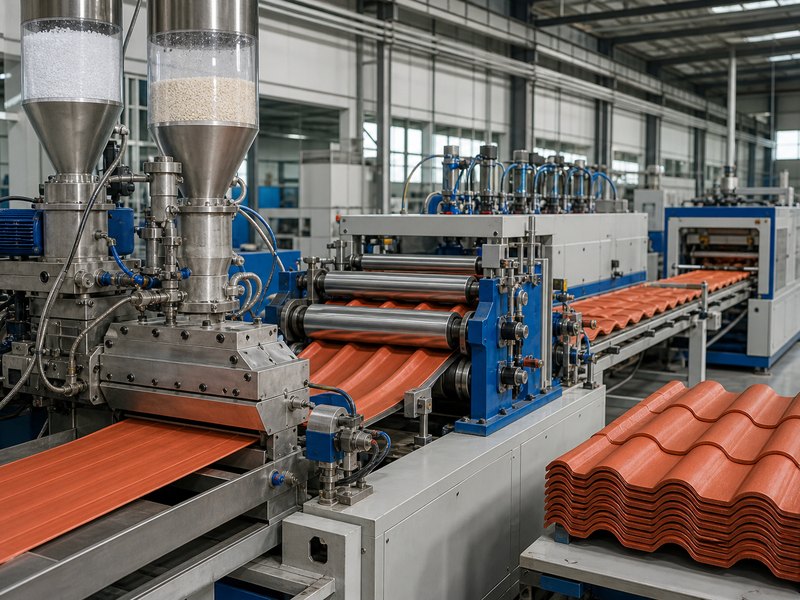
ASA synthetic resin roof tile manufacturing is a continuous process that combines a PVC-U body with an ASA weathering surface, forms both materials into a layered sheet, creates the roof profile, stabilizes it by controlled cooling, and cuts it to length. The line may look sequential, but product consistency depends on all stages remaining synchronized.
The central manufacturing challenge is not simply melting plastic. A tile must keep its layer interface, widthwise profile, repeated steps along its length, dimensions, surface appearance, and mechanical response within controlled boundaries. A disturbance at one stage often appears as a defect several metres farther down the line.
What controls an ASA synthetic resin roof tile?
| Control layer | Manufacturing question | Typical evidence |
|---|---|---|
| Compound identity | Are the ASA and PVC-U materials consistent with the approved formulation and batch? | Material identity, lot records, controlled preparation, and relevant incoming checks |
| Melt and interface | Do separate melt streams reach the die in a stable condition and form a continuous bond? | Process records, layer continuity, surface uniformity, and cross-section inspection |
| Geometry | Are the wave section and repeated tile steps formed at the intended pitch and depth? | Profile gauges, step spacing, Breite, effektive Abdeckung, and edge geometry |
| Cooling and handling | Does the sheet solidify without trapped distortion before cutting and stacking? | Flatness, dimensional stability, cooling balance, haul-off synchronization, and stack condition |
| Verification | Can the finished sheet be traced and evaluated at the correct evidence level? | Batch code, dimensions, appearance, test records, retained samples, and release status |
These controls form one chain. A stable compound cannot compensate for an uneven die. A balanced die cannot prevent distortion if cooling pulls one region faster than another. A visually straight tile still needs material, dimensional, and traceability records.

How are the PVC-U body and ASA surface prepared?
The body normally begins as a rigid PVC-based compound rather than pure resin alone. Stabilizers, Verarbeitungshilfsmittel, impact modifiers, Pigmente, fillers, and other controlled ingredients can change flow, fusion, toughness, heat response, Farbe, and cost. Their identity and proportion belong to a managed formulation.
The exposed layer uses ASA material selected for outdoor surface duty. ASA is not a generic synonym for every colored cap. ISO 19065 classifies ASA extrusion materials through composition and properties such as melt flow, Vicat softening behavior, Schlagfestigkeit, and modulus. That framework supports material control, but it does not define a complete roofing formula.
Incoming measurements also need boundaries. Melt mass-flow or volume-flow data can help compare thermoplastic lots under fixed conditions. ISO 1133 notes that its test uses much lower shear than normal processing, so the result cannot reproduce the material history inside a roof-tile die. Vicat softening temperature is likewise a controlled material indicator, not a direct roof-service limit or a forming recipe.
For an ASA roofing sheet, the useful question is therefore not whether ASA appears in the product name. The factory must keep the specified material identity, surface continuity, Farbe, interface, and finished geometry under repeatable control.
How does co-extrusion create one layered sheet?
Co-extrusion keeps the ASA and PVC-U materials in separate flow paths until they meet in a purpose-designed die or feedblock. Each extruder develops its own melt stream. The streams then join while both surfaces remain able to form an interface.
Stable joining requires more than simultaneous feeding. Flow balance affects layer distribution across the width. Temperature and residence history affect melt condition. Contamination or an unstable feed can interrupt the interface. A surface stream that fluctuates can create streaks, thin zones, or color variation even when total sheet thickness appears acceptable.
The visible edge is useful because it can reveal layer continuity and gross variation. It cannot prove bond strength, weathering resistance, or the composition of each layer by sight alone. Those questions need defined inspection or test methods and traceable specimens.
ISO 19065-2 and ISO 21306-2 also explain why specimen preparation matters. ASA and PVC-U values depend on handling, conditioning, dimensions, procedure, and thermal history. Data from a standard material specimen should not be silently assigned to a formed, multilayer roof tile.
How is the Spanish tile geometry formed?
A Spanish-style Dachziegel aus ASA-Kunstharz contains geometry in two directions. Across its width, crests and drainage channels establish the continuous roof section. Along its length, repeated raised steps create the tile rhythm and overlap appearance.
This distinction matters because a static extrusion die produces a continuous cross-section. It can establish the widthwise distribution of the sheet, but it cannot by itself create a shape that repeatedly changes along the machine direction. Synchronized downstream forming equipment must create the longitudinal tile steps while the sheet remains formable.
Forming speed must follow extrusion and haul-off speed. If the timing drifts, step spacing can change. If pressure or temperature differs across the width, one side may show a deeper step or sharper detail than the other. If the sheet enters the former with uneven layer or temperature distribution, the surface may stretch differently over crests, pans, and step corners.
Profile control therefore needs more than total width. Useful checks include crest and pan geometry, step pitch, step depth, side-lap shape, edge straightness, effektive Abdeckung, and the relation between repeated features and cut length. These dimensions control how successive sheets align even when each tile looks acceptable in isolation.
Why are cooling and haul-off part of product design?
The formed sheet leaves the hot zone before its final dimensional state is secure. Cooling removes heat and raises stiffness, while guides and haul-off equipment control movement. The process must restrain the intended shape without freezing uneven stress into the tile.
Uneven cooling can contract one surface or one side sooner than another. The result may appear as bowing, twisting, edge lift, or profile drift. Excessive pull can change dimensions. Unstable pull can vary step spacing or disturb the layer while it is still warm.
Thermal history remains important after the tile looks solid. ISO 21306-2 notes that thermal history and internal stress can strongly influence thermal and mechanical properties of PVC-U specimens. A finished tile adds profile curvature, layer interfaces, Schneiden, stacking, and storage conditions to that history.
Cutting must follow the moving product without dragging or crushing the profile. Length control normally depends on a synchronized measurement signal. Freshly cut tiles then need support that preserves their shape. A warm, uneven, or overloaded stack can record distortion that did not exist at the cutter.
Which quality checks belong at each evidence level?
Quality control becomes clearer when evidence is separated by level. Raw-material checks characterize controlled compounds. Process records describe the conditions used to make the sheet. Product checks inspect the finished tile. Roof-system evidence adds supports, overlaps, Verbindungselemente, Neigung, Klima, und Installation.
| Evidence level | What it can support | What it cannot prove alone |
|---|---|---|
| Raw material | Compound identity and specified material properties under defined methods | Layer uniformity, tile geometry, or roof performance |
| Process | Traceable production conditions and stability of controlled variables | Performance without calibrated inspection and product testing |
| Finished tile | Dimensions, appearance, layer continuity, mass, and defined mechanical or weathering results | Every span, fastener, Klima, load, or installation condition |
| Roof assembly | Behavior of the tested profile, supports, joints, Verbindungselemente, and configuration | Untested layouts or universal service life |
Flexural testing illustrates this boundary. ISO 178 can compare rigid plastic specimens under controlled three-point bending conditions. It also states that specimen size, preparation, speed, and conditioning affect comparability, and that the result is not a structural design parameter. A profiled tile or installed roof requires evidence that preserves its actual geometry and support conditions.
Surface weathering needs the same discipline. ISO 4892-2 controls xenon-arc light, Feuchtigkeit, Temperatur, Luftfeuchtigkeit, and wetting. Such exposure can compare property or color change under a defined cycle. It does not convert automatically into a universal outdoor lifespan. The HESU analysis of plastic roof tile color fading explains why surface material, pigment, layer continuity, processing, Klima, and installation context remain connected.
What do common defects reveal about the process?
| Observed condition | Process areas to investigate | Evidence needed before a conclusion |
|---|---|---|
| Color streak or gloss band | Surface feed, pigment dispersion, melt stability, die distribution, or contamination | Batch identity, cross-width sample map, process record, and surface inspection |
| Layer separation | Interface contamination, material compatibility, melt condition, residence history, or joining pressure | Cross-section location, retained sample, interface test method, and affected production window |
| Uneven tile steps | Former timing, pressure balance, sheet temperature, haul-off speed, or incoming thickness distribution | Step-pitch measurements, widthwise profile map, and synchronized line records |
| Warping or edge lift | Cooling imbalance, residual stress, pull alignment, warm stacking, or unsupported storage | Flatness measurements over time, cooling record, stack condition, and temperature history |
| Brittle cut edge | Compound variation, processing history, cooling state, cutting condition, or sample damage | Batch comparison, edge inspection, conditioned specimens, and defined mechanical checks |
| Length drift | Encoder, haul-off stability, cutter synchronization, or product slip | Sequential length record, line-speed history, and measurement-system check |
A defect table narrows investigation; it does not identify one cause from appearance alone. Several process changes can produce similar marks, and one process disturbance can create several symptoms. Traceability turns the visible condition into a defined production interval that can be sampled and compared.
Frequently asked questions
Is ASA mixed through the whole synthetic resin roof tile?
Not necessarily. In an ASA-faced co-extruded tile, ASA forms the exposed weathering layer while a PVC-U compound forms most of the body. The exact layer architecture must come from the verified product specification.
Does the extrusion die create the complete Spanish tile shape?
It can establish the continuous section across the sheet. Repeated steps along the production direction require synchronized downstream forming because a static die produces a constant cross-section.
Can a visible layered edge prove co-extrusion quality?
It can reveal gross continuity and obvious variation at that location. It cannot prove composition, bond strength, cross-width uniformity, or weathering performance without defined records and tests.
Does an ASA material test prove roof-tile service life?
NEIN. Material tests characterize controlled specimens under stated methods. Finished-tile geometry, layer distribution, processing history, supports, Verbindungselemente, Klima, Installation, and maintenance add separate variables.
Technical conclusion: ASA synthetic resin roof tile manufacturing is best understood as a synchronized control system. Compound identity starts the process, but interface formation, two-direction profile geometry, cooling history, dimensional control, and traceable verification determine whether the finished tile consistently represents the intended product.