
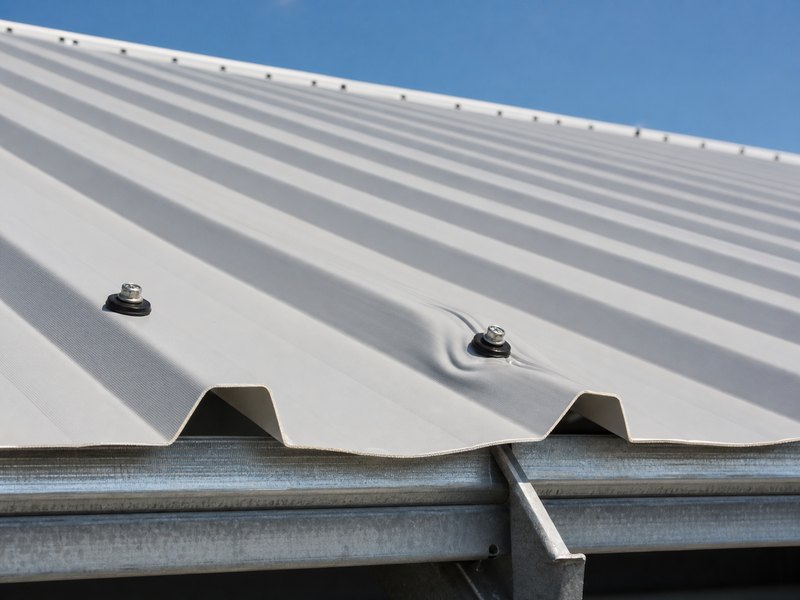
Plastic roofing heat deformation does not come from heat alone. Plastic sheets naturally expand in strong sunlight and contract as they cool. Visible warping develops when that movement meets tight fasteners, uneven supports, unstable profile geometry, poor storage, or aged material. The first task is therefore to identify the type of movement, not to label every uneven sheet as heat damage.
HESU separates four conditions that often look similar from the ground: normal daily movement, local buckling near a restraint, sagging between supports, and permanent shape change. Each condition has a different stress path and needs a different technical response.
What causes plastic roofing heat deformation?
Sunlight raises the sheet temperature above the surrounding air temperature. The sheet then tries to grow along its length and width. A long panel accumulates more dimensional movement because every section contributes to the total change.
If the fixing holes, Unterlegscheiben, side laps, ridge details, and edge clearances allow controlled movement, the roof can complete this daily cycle without obvious distortion. If screws clamp the sheet too tightly, the panel cannot move freely. Compression then collects near the fastener, lap, or end restraint. The sheet may rise, wrinkle, or push sideways.
Heat also reduces the stiffness of many thermoplastics. A warm sheet carries less resistance against gravity and wind pressure than the same sheet at a lower temperature. Wide purlin spacing, a shallow profile, or an uneven support line can therefore reveal sagging during the hottest part of the day.

Is the sheet moving normally or permanently warping?
| Visible condition | Typical pattern | Likely mechanism | Technical focus |
|---|---|---|---|
| Normal thermal movement | Small change that reduces after cooling | Reversible expansion and contraction | Movement clearance and stable seals |
| Restraint buckling | Wrinkle or raised area near a screw, lap, ridge, or wall | Expansion meets a fixed point | Hole clearance, Scheibendruck, and edge space |
| Support sagging | Repeated low areas between purlins | Warm sheet loses stiffness across an excessive or uneven span | Profile capacity and support layout |
| Permanent deformation | Shape remains after the roof cools | Material, aging, prolonged load, severe local heat, or production damage | Product condition, heat source, and factory records |
This distinction prevents a common diagnostic error. A roof that changes shape with the daily temperature cycle does not show the same failure as a panel that stays twisted overnight. Location also matters. A wrinkle around one screw points toward restraint. A repeated sag between every purlin points toward support or profile capacity.
How does heat travel through the roof system?
The stress path has five stages. First, solar radiation heats the exposed surface. Second, the material expands. Third, fasteners or details restrict part of that movement. Fourth, stress concentrates around the restriction. Finally, the roof displays buckling, enlarged holes, lifted laps, washer movement, or a changed drainage line.
Color influences the first stage because darker surfaces generally absorb more solar energy than light surfaces. Roof orientation, shade, indoor heat, and ventilation also change the temperature pattern. A panel beside a hot exhaust outlet may deform locally even when the rest of the roof remains straight.
Uneven heating can matter as much as peak heat. A shaded edge beside a sunlit field creates a temperature difference within one sheet. Tight wall flashing or a rigid ridge detail can then turn that uneven growth into a visible wave near the boundary.
Why do PVC and UPVC profiles behave differently?
Material formulation changes rigidity, Aufprallverhalten, and dimensional response. A PVC-Dachbahn can offer practical flexibility and easy handling, but its roof line still depends on profile depth, Dicke, Stützabstand, and fastening control.
An UPVC-Dachbahn usually emphasizes a more rigid structure. That rigidity can support profile stability, yet it does not remove thermal movement. An over-tightened UPVC panel can transfer stress toward the hole or edge instead of showing a broad flexible wave.
Profile geometry works with the material. Corrugations and trapezoidal ribs increase stiffness across the sheet and create drainage channels. Deeper or more frequent ribs can change span behavior, but the profile cannot compensate for every support error. Effective coverage, side-lap fit, and purlin alignment still control how neighboring sheets share movement.
Which installation details control visible distortion?
Fixings need to hold the roof against uplift while allowing the sheet to respond to temperature. Plastic roofing guidance commonly uses pre-drilled clearance around the screw rather than a tight self-drilled fit. The fastener should sit near the center of that clearance so the sheet can move in more than one direction.
The washer needs even contact, but excessive compression can dish the panel around the fixing point. A screw that enters at an angle can load one side of the hole. Repeated thermal cycles may then enlarge the contact area or pull the washer away from a flat sealing surface.
Support lines must remain straight and match the product’s span guidance. A high or twisted purlin forces the panel into shape before the sun adds thermal stress. End laps also need support. Where movement changes the overlap or washer seal, the symptoms can connect with the mechanisms described in HESU’s article on why PVC roofing sheets leak.
Roof edges need equal attention. Tight contact against walls, fascia, ridge components, or rigid closures can lock the panel. Ventilation below the roof can reduce trapped heat, but ventilation cannot correct crushed washers or an uneven frame.
How can factory control reduce shape problems?
Shape stability begins before installation. Extrusion needs consistent material feeding, thickness control, profile forming, and balanced cooling. If one area cools faster than another, internal stress can remain in the sheet. The panel may look acceptable in a short stack yet reveal twist after heating on the roof.
Profile repeatability also affects side laps. Two sheets with inconsistent rib geometry do not nest evenly. Installers may use extra screw pressure to close the gap, which introduces restraint before the first hot day.
Storage can add another stress layer. Long sheets need flat, continuous support in a shaded, ventilated location. A hot stack on uneven ground can take a set under its own weight. Concentrated strap pressure can mark edges or flatten ribs. HESU treats stacking and handling as product-control steps because the roof cannot recover every shape error during fixing.
How should a distorted roof be examined?
Start with the pattern. Distortion at isolated fasteners suggests local restraint or torque. Repeated sagging between supports suggests a span, Dicke, or profile issue. Movement at every end lap suggests accumulated sheet length and restrained joints. Damage near an exhaust, reflective wall, or transparent rooflight suggests local heat concentration.
Next, compare hot and cool conditions. A reversible wave belongs to a different category from a permanent crease. Check whether the washer remains flat, whether the hole has elongated, and whether side laps still nest without force. Inspect the supporting frame for a high point or twist.
Do not loosen structural fixings without a roof-specific review. Wind uplift, sheet profile, purlin material, fastener type, and local code all affect the fixing pattern. The safe correction must preserve both movement allowance and roof attachment.
Can heat deformation be prevented completely?
No roof remains dimensionally motionless. The practical goal is controlled movement without loss of drainage, sealing, attachment, or profile shape. Product formulation, stable extrusion, suitable color, correct sheet length, straight supports, centered clearance holes, balanced washer pressure, and ventilated details work as one system.
Plastic roofing is also not suitable beside every heat source. Industrial exhaust, radiant equipment, concentrated reflection, and unventilated cavities can create local conditions beyond ordinary weather exposure. The roof design must separate the sheet from those sources or use a material system designed for that environment.
Frequently asked questions
Does every plastic roof expand in sunlight?
Plastic roofing materials expand as their temperature rises. The amount and visible effect depend on formulation, Blattlänge, Profil, Farbe, Befestigung, and edge clearance. Controlled movement is normal. Buckling or damaged seals indicate that the roof system has restricted or concentrated that movement.
Does a more rigid sheet eliminate heat movement?
NEIN. Higher rigidity can help a profile retain shape, but it does not stop thermal expansion. A rigid sheet may concentrate stress around holes or edges when fasteners and details prevent movement.
Why does deformation appear near one screw?
The screw may sit off-center in the clearance hole, enter at an angle, or compress the washer too strongly. A high purlin beneath that point can add stress. The nearby sheet then buckles when heat-driven expansion reaches the restraint.
Can ventilation fix a warped plastic roof?
Ventilation can reduce trapped heat and improve the roof environment. It cannot repair permanent material deformation, uneven supports, tight edge details, or over-compressed fixings. Diagnosis must identify the controlling mechanism first.
Technical takeaway: temperature starts the movement, but roof details decide the outcome. A reliable plastic roof gives that movement a controlled path while preserving attachment, überlappen, Drainage, and profile geometry.