
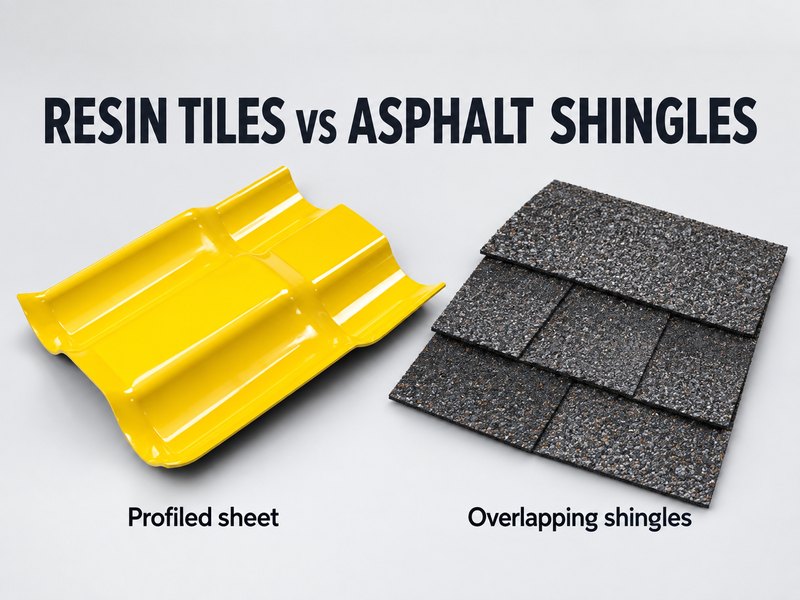
Resin roof tiles and asphalt shingles suit different roof constructions. Profiled resin sheets suit broad roof planes where a raised tile appearance and sheet-based installation matter. Asphalt shingles suit a continuous roof deck and can accommodate many short roof sections and junctions. Neither material is the better choice for every roof.
The biggest difference sits underneath the visible surface: a resin sheet can span between correctly designed supports; an asphalt shingle cannot. That distinction affects installation, renovation work and the finished roof far more than a color comparison.
Первый, distinguish a resin sheet from a shingle
HESU Черепица из синтетической смолы ASA combines an exposed ASA weathering surface with a shaped resin or PVC-based body. Several apparent tile rows form one continuous sheet. This is not the same product as separate composite slate or shake shingles, which also appear under the broad name “synthetic roofing.”
A typical modern asphalt shingle uses a fiberglass mat, asphalt coating and exposed mineral granules. The asphalt sheds water; the granules provide color and shield the asphalt from sunlight. Installers lay shingle strips in overlapping courses. Architectural shingles add laminated layers, producing a different texture from a molded Spanish-tile wave.
The roof deck changes the installation
Asphalt shingles need a suitable, continuous nailable deck, commonly plywood or oriented strand board (OSB). The deck supports the shingles and holds their fasteners. Underlayment goes between the deck and the covering; it provides another water-management layer. A row of separated purlins is not a substitute for that deck.
Profiled resin tile sheets can bridge a specified distance between supports. Their formed shape contributes stiffness, while the fixing pattern connects each sheet to the supporting roof structure. The allowable spacing depends on the particular sheet and roof design. A lightweight sheet does not remove the need for a sound frame or correctly supported roof edges.

This creates a practical renovation boundary. Changing a purlin-supported resin roof to asphalt shingles means adding an appropriate deck and its associated details. Changing a decked shingle roof to resin sheets means designing the new support and fixing arrangement. Neither change is simply a swap of visible coverings. The broader implications of resin roofing sheets in roof renovation include the condition and connections of the structure that remains.
Resin roof tiles vs asphalt shingles at a glance
| Comparison point | Profiled resin roof tiles | Asphalt shingles |
|---|---|---|
| Installed form | Larger sheets with molded waves and tile steps | Smaller strips laid in overlapping courses |
| Поддерживать | Designed support lines matched to the sheet | Continuous, suitable nailable roof deck |
| Attachment | Profile-compatible mechanical fixings and sealing details | Nails in the specified zones, with shingle sealing strips |
| Visible character | Raised, repeating tile contours | Granulated surface with flat or dimensional courses |
| Localized replacement | A matching sheet may extend well beyond the damaged spot | Individual damaged strips may be replaceable if adjacent shingles remain serviceable |
These are construction differences, not performance scores. A product’s fire, wind or impact rating applies to its tested configuration, not every roof made from the same material.
Two roof shapes reveal the practical trade-off
A simple gable with uninterrupted slopes
Broad rectangular roof planes make good use of sheet format. A resin sheet covers several visible tile rows in one placement. Fewer interruptions mean fewer places to cut around dormers or reconcile the repeating profile with a junction.
А синтетическая испанская черепица also produces a pronounced curved roofline rather than a nearly flat shingle surface. That architectural difference is visible from the street, even when both coverings share a similar color. Asphalt shingles can serve a simple gable too, but their installation still proceeds course by course over a deck.
A roof interrupted by dormers, valleys and short returns
Smaller shingle units offer useful layout flexibility around short roof sections. Installers can stagger courses and integrate flashing as the work progresses. Each junction still needs a complete drainage detail; flexibility does not make valleys or wall connections automatically watertight.
Resin sheets can also cover multi-slope roofs. Однако, each interruption reduces the area that a full sheet can cover without cutting. The profile must meet suitable hip, ridge and valley details. As the roof becomes more fragmented, large-sheet coverage becomes a smaller advantage. This is a layout judgment, not a claim that one material always installs faster.
Heat and durability need a fair comparison
Neither “plastic” nor “asphalt” tells you how hot the occupied room will become. Solar reflectance affects how much sunlight the surface absorbs. Thermal emittance affects how readily it releases heat. Insulation and the roof assembly then influence heat transfer indoors. Reflective asphalt shingles exist, so dark conventional asphalt is not a fair stand-in for every shingle option.
The Cool Roof Rating Council explains these surface radiative properties. Compare measured values for the actual colors and products, where available. A resin surface layer is not a substitute for insulation, and a pale appearance alone does not establish a cool-roof rating.
For wind resistance, shingle nailing and the bond between courses work together. Resin-sheet performance depends on its sheet-to-support connections and the specified fixing arrangement. Neither the number of pieces nor the apparent rigidity establishes a wind rating.
Fire performance also needs an assembly-level comparison. Underlayment and the supporting deck can affect the classification. An isolated flame demonstration or a material description cannot replace the applicable roof-system test. Without comparable product evidence, declaring either covering longer-lasting, fireproof or stormproof would be misleading.
Think about the next repair, not just the first installation
A damaged shingle may allow a relatively localized repair. That advantage shrinks when surrounding shingles are brittle or lifting them would cause further damage. A resin-sheet repair may involve a larger replacement piece, matching its profile and releasing adjacent laps or accessories. Spare matching materials therefore have different practical value for the two systems.
The useful distinction is straightforward: resin sheets combine a sculpted tile appearance with larger-area placement; asphalt shingles combine a deck-supported covering with smaller-unit layout flexibility. For a broad, simple roof, the sheet format can be a strong fit. For a fragmented roof already designed around a continuous deck, shingles can be the more straightforward construction. Start with that fit, then compare the exact product performance.