
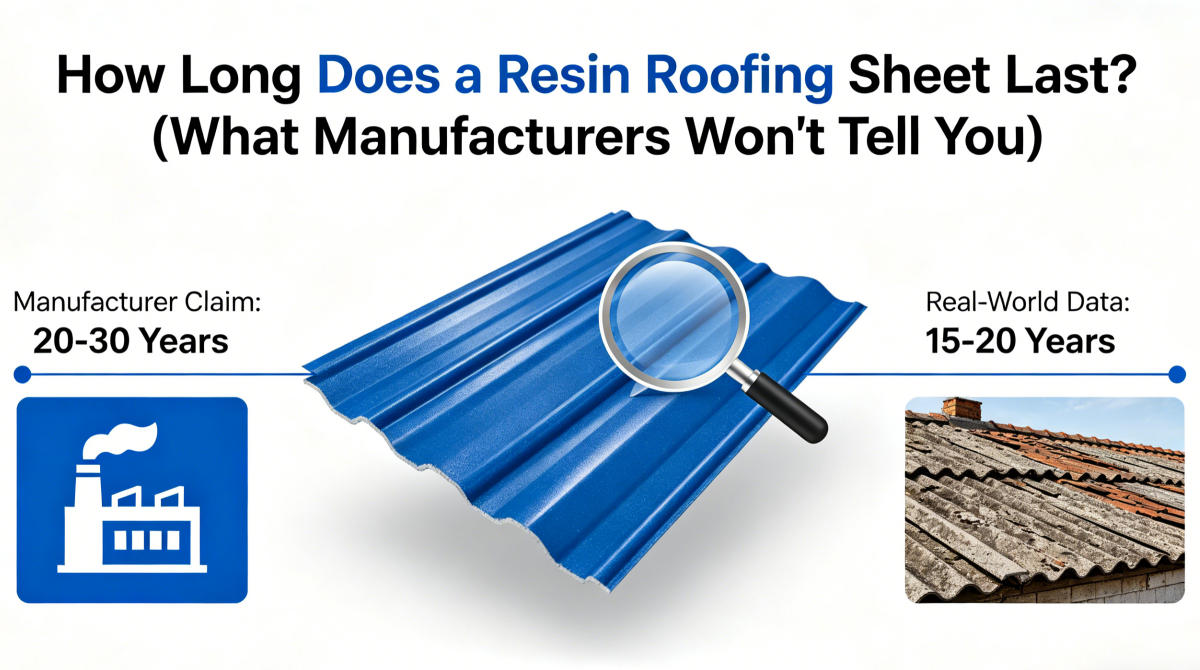
Vaya a cualquier mercado de materiales de construcción y pregúntele a un proveedor cuánto tiempo durará su láminas de resina para techos último. Obtendrás la misma respuesta cada vez.: 30 años. Pregunta a otro proveedor. 30 años. Pregúntale a un tercero. Aún 30 años.
El número es real, pero sólo en condiciones que la mayoría de los tejados nunca ven..
Después de años de trabajar en la cadena de suministro de techos de resina, la versión honesta de esa respuesta es más complicada. El producto correcto, instalado correctamente, en el clima adecuado, realmente dura 20 a 30 años. Pero muchos techos no logran pasar 8. No porque la categoría sea defectuosa., pero debido a que hay varias cosas que determinan la vida útil que nadie en el proceso de ventas tiene ningún incentivo para explicar claramente.
Esto es lo que realmente necesitas saber.
La brecha de la que nadie habla
Básicamente, existen dos niveles de láminas de resina para techos en el mercado., y no se comportan en nada parecidos.
Láminas de alta calidad: fabricadas con una capa superficial de ASA adecuada y una base de PVC de alta calidad - espera por 20 a 30 años en condiciones normales. Algunos sobreviven a eso. Soportan la exposición a los rayos UV sin volverse quebradizos., se flexionan ligeramente en los cambios de temperatura sin agrietarse, y no se desvanecen a un color gris tiza dentro de los primeros cinco años..
Las hojas de presupuesto, las que llenan el extremo inferior de los catálogos mayoristas, utilizan capas protectoras más delgadas., relleno reciclado en el material base, o sustituir el plástico ABS más barato donde debería estar el ASA. En un clima templado con mínimo estrés., podrían durar una década. En zonas costeras, regiones calientes, o entornos industriales, 3 a 5 años es un resultado realista.
La diferencia de precios entre estos dos niveles suele ser sorprendentemente pequeña a nivel de hoja.. La brecha en el costo de reposición es enorme.
Lo que realmente determina cuánto dura su techo
La capa ASA: la especificación que más importa
Cada lámina de resina para techos tiene un revestimiento superficial que se supone protege el material base de la radiación UV.. Esta es la capa ASA, y su espesor es el número más importante en toda la especificación del producto.
Una hoja correctamente hecha tiene una capa ASA de 0,15 mm o más. Eso es suficiente para absorber años de exposición a los rayos UV sin que el material base que se encuentra debajo se degrade..
Muchos productos de menor costo reducen esto a 0,08 mm o menos.. Algunos omiten el ASA por completo y usan ABS en su lugar, un plástico más barato que casi no tiene resistencia a los rayos UV.. No verás esta diferencia cuando lleguen los mosaicos.. Lo verás en el año cuatro o cinco., cuando la superficie comienza a volverse calcárea y las baldosas se vuelven lo suficientemente quebradizas como para agrietarse con el tráfico peatonal.
Al comprar, Solicite un informe de prueba sobre el espesor de la capa de ASA.. Un proveedor que no puede o no quiere proporcionar uno le está diciendo algo importante.
El calor es un problema mayor de lo que la mayoría de la gente cree
Los fabricantes prueban sus productos a temperaturas controladas de laboratorio.. No los prueban en el tejado de una fábrica de Guangdong en agosto, donde las temperaturas de la superficie pueden superar los 70°C durante meses seguidos.
El calor acelera el envejecimiento del material de forma muy mensurable. Una hoja clasificada para 30 años en un clima moderado envejece aproximadamente 1.5 a 2 veces más rápido en condiciones de calor elevado y sostenido. Esa no es una advertencia enterrada en letra pequeña: es la química básica de los polímeros.. Pero casi nunca surge en una conversación de ventas..
Si su edificio se encuentra en un clima cálido, Tiene fuentes de calor internas, como equipos industriales, que empujan el calor hacia el techo., o enfrenta largas horas de exposición directa al sol sin sombra, necesitas tener esto en cuenta. Seleccione un producto específicamente clasificado para entornos de alta temperatura, o ajustar sus expectativas de vida en consecuencia.
Errores de instalación que ningún contratista ofrecerá voluntariamente
Esto es incómodo porque significa que el techo puede fallar sin que sea culpa del material, y el fabricante usará eso para evitar responsabilidad..
dicho eso, Una mala instalación realmente acorta la vida útil del techo de resina en 30 a 50%, incluso en productos de buena calidad. Los problemas más comunes no son complicados:
La superposición de baldosas demasiado corta (menos de 80 mm) permite que la lluvia impulsada por el viento se abra camino debajo de las láminas.. Con el tiempo, La humedad atrapada deforma la estructura y acelera la corrosión en las fijaciones..
Los tornillos demasiado apretados agrietan la loseta alrededor del punto de fijación. Los tornillos no están lo suficientemente apretados y permiten que las baldosas se muevan con el viento. Ambos son más comunes de lo que deberían ser..
Sin espacio de expansión en los orificios para tornillos. La resina se expande y contrae con la temperatura.. Una baldosa fijada rígidamente en todos los puntos no tiene adónde ir cuando se calienta. Se agrieta en su lugar.
Nada de esto es complicado, pero requiere un instalador que esté realmente familiarizado con el material, no alguien que aplique los mismos hábitos que usan para los techos de metal..
Costero, Industrial, y entornos con mucha nieve
Las especificaciones estándar de las láminas de resina para techos se basan en condiciones estándar.. aire salado, lluvia ácida, vapores químicos, y una carga de nieve intensa y persistente no son condiciones estándar, y un producto genérico colocado en estos entornos se degradará significativamente más rápido de lo que sugiere la etiqueta..
En zonas costeras con niebla salina constante, o en instalaciones donde se escapen vapores corrosivos cerca de la línea del techo, La vida útil puede reducirse a un tercio de lo que se vería en un edificio residencial normal.. Esto no es un fallo del producto, es una discrepancia en las especificaciones. La solución es seleccionar un producto que esté específicamente formulado para el entorno al que se dirige., no es la lámina más barata que técnicamente cubre el área del techo.
El reclamo de 30 años tiene condiciones adjuntas
La mayoría de los fabricantes respaldan en marketing su cifra de vida útil de 30 años.. La mayoría de los fabricantes ofrecen un 5 a 10 años de garantía real. Esa brecha te dice algo.
La cifra de 30 años refleja el rendimiento del material en condiciones de prueba controladas.. No cubre daños por granizo, errores de instalación, factores ambientales fuera de los parámetros normales, o cualquier otro escenario donde la responsabilidad pueda redirigirse a algo que no sea el producto.
Antes de comprometerse con un proveedor, Solicite la garantía por escrito y lea lo que realmente está cubierto.. Un proveedor que confía en su producto tendrá una clara, documento ejecutable. Quien no lo sea le dará una vaga seguridad verbal..
Cómo sacarle realmente 20 a 30 años a un techo de resina
Nada de esto requiere conocimientos especializados.. Requiere hacer las preguntas correctas antes de comprar y ser un poco más exigente que el comprador medio..
Solicite un informe de prueba del material que confirme un espesor de la capa de ASA de 0,15 mm o más y una composición de la capa base de al menos 80% PVC virgen. Estos documentos existen para todos los fabricantes legítimos, si un proveedor no puede producirlos., siga adelante.
Contrate un equipo de instalación con experiencia específica en techos de resina., no solo experiencia general en techado. Preguntar para ver proyectos terminados. La diferencia de coste entre un instalador medio y uno competente es pequeña; la diferencia en el rendimiento del techo a largo plazo es significativa.
Si su sitio está en un clima cálido, ubicación costera, o entorno industrial, especifique eso por adelantado y solicite una recomendación de producto que coincida con esas condiciones. No asuma que el producto estándar es apropiado.
Revisa el techo anualmente. Limpiar escombros de valles y canalones, busque baldosas rotas o fijaciones sueltas, y solucionar pequeños problemas antes de que se conviertan en entrada de agua. Un techo de resina en buenas condiciones necesita muy poco, pero ignorarlo por completo durante una década tiende a terminar mal.
Preguntas frecuentes
¿Cuál es la vida útil realista de las láminas de resina para tejados?? Producto de alta calidad, instalación correcta, clima moderado: 20 a 30 años es alcanzable. Producto económico, ambiente cálido o costero, atajos de instalación: 5 a 10 años es más realista. La categoría funciona, pero la variación es lo suficientemente grande como para que la selección de productos sea muy importante.
¿Por qué las láminas de resina baratas para tejados fallan prematuramente?? Generalmente la capa ASA. Productos con capas inferiores a 0,08 mm., o aquellos que sustituyen ABS por ASA por completo, Pierde la protección UV en unos pocos años.. Una vez que la superficie se degrada, el material base se agrieta rápidamente, desvanecimiento, y eventualmente goteando.
¿Cuánto afecta el calor a la vida útil?? De modo significativo. Las superficies del tejado que superan regularmente los 60°C envejecen aproximadamente 1.5 a 2 veces la tasa de instalaciones de clima moderado. Un producto con una calificación de 30 años en un ambiente industrial caluroso podría durar de manera realista 15 a 18 años.
¿Qué errores de instalación acortan más la vida útil del techo?? Superposición de baldosas insuficiente (menos de 80 mm), torque de tornillo incorrecto, y los espacios de expansión faltantes son los más comunes. En conjunto, pueden reducir la vida útil efectiva al 30 a 50%, independientemente de la calidad del producto.
¿Cómo verifico las afirmaciones de calidad de un proveedor?? Solicite un informe de prueba de terceros sobre el espesor de la capa de ASA y la composición del material base. Solicite el documento de garantía por escrito antes de comprar.. Un proveedor que confíe en su producto tendrá ambos disponibles.