
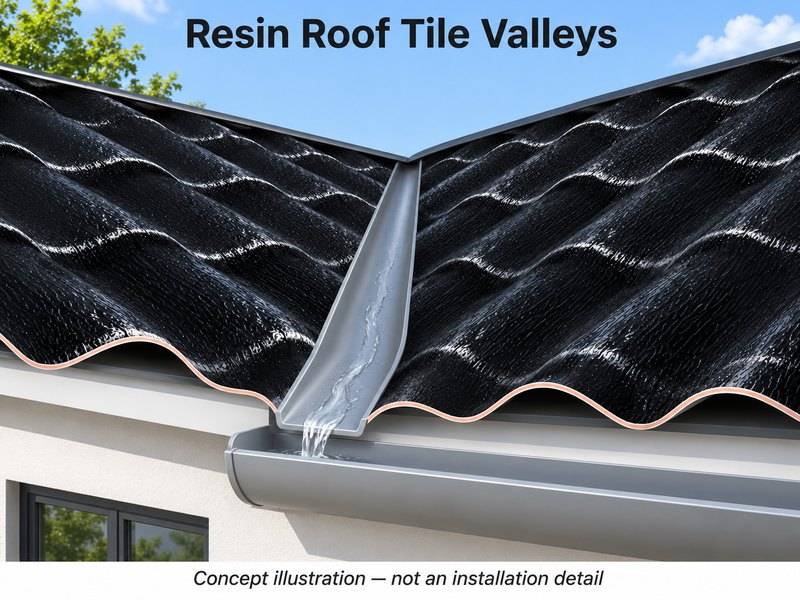
A resin roof tile valley needs a continuous route for water, secure support beside the cut sheets and a clear discharge into the gutter. Sealant alone cannot provide those three functions. The valley is the inward junction between two roof slopes; it collects runoff rather than shedding water away like a ridge.
For profiled resin roofing, an open lined valley is one possible arrangement when the roof-system design supports it. The lining, channel width, sheet termination and fixings must suit the actual profile and roof geometry. This explanation covers how the junction works, not a universal set of installation dimensions.
Follow one drop of water through the junction
Rain moves down both roof faces toward the valley. The channel then carries that combined flow to its outlet. A sound detail must work at the entrance, along the run and where it meets the eaves gutter.
These locations do different jobs. The entrance must receive water without directing it behind the lining. The run must remain unobstructed. The outlet must discharge into the gutter rather than behind the fascia. A neat-looking line of cut tiles does not prove that all three connections work.
The catchment also matters. A short valley serving two small slopes does not receive the same runoff as a valley beneath a larger upper roof. Equal visible channel widths do not establish equal drainage capacity.
Resin roof tile valleys are not ordinary sheet laps
On a straight slope, neighboring sheets join along their formed side laps. At a valley, a diagonal cut interrupts the repeated profile. The cut can pass through a crest, a trough or a stepped portion of the sheet. That changes the shape and stiffness of the remaining edge.
JESUS Telhas de resina sintética ASA have a shaped sheet body rather than separate small tiles. A valley layout therefore needs to coordinate the sheet pattern with the cut line and the supporting structure. Leaving a narrow corner unsupported is not equivalent to supporting a full-width sheet on a normal roof run.

The design has to reconcile two needs: enough support and restraint for the cut sheet, and enough unobstructed space for drainage. Pushing the sheet farther into the channel may improve its apparent reach while reducing the waterway. Pulling it back without a support detail can leave an unstable edge.
That balance explains why a generic valley-gap measurement is not a reliable answer. Inclinação do telhado, contributing area, valley length, profile depth and the lining system all affect the detail. Clay-tile instructions can explain general drainage principles; their dimensions and fixing rules do not automatically apply to a resin sheet.
A raised cap does the opposite job
A ridge or hip cap covers an outward junction and sheds rain onto neighboring roof faces. A valley receives water from those faces. Reversing a ridge fitting does not turn it into a designed valley gutter.
The same distinction applies to HESU Acessórios para telhas espanholas. Matching color or a familiar tile shape does not establish the component’s function. Pedaços de cume, end caps and junction connectors are not substitutes for a specified valley lining.
Three observations that explain many valley leaks
The channel contains debris or sealant ridges
Leaves, cuttings and misplaced repair material can interrupt discharge. Water may spread sideways or rise against the sheet edges instead of following its intended route. Adding another bead of sealant can worsen an obstruction without addressing its cause.
The visible edge moves or has lost its support
A cut sheet that lifts, distorts or no longer sits correctly needs its support and fixing arrangement examined. Surface patching does not restore missing restraint. The correction concerns the junction construction, not just the exposed seam.
The stain sits below an apparently clear valley
Water can enter higher up or travel along concealed surfaces before appearing indoors. The stain location alone does not identify the entry point. Inspection should include the valley head, lining joints, nearby penetrations and the outlet—not only the spot above the stain.
These are inspection clues, not a remote diagnosis. Existing roof conditions determine the repair. Inspection also needs safe access: the HSE’s fragile-surface guidance applies to short maintenance jobs as well as larger roof work.
Judge the valley from top to bottom
A useful junction drawing shows more than the middle cross-section. It connects the valley head to its gutter outlet and identifies how the cut sheets remain supported. It also keeps any secondary water-shedding layer consistent with that route, where the roof assembly includes one.
Roof slope remains part of this assessment. Nossa explicação de resin roof tile pitch and drainage covers the wider relationship between slope and water shedding. A well-finished valley cannot compensate for a roof layout outside the selected system’s application limits.
The practical test is simple: can water enter, travel through and leave the valley without depending on a cosmetic seal? If the answer is unclear, the junction needs a drainage and support detail before it needs more sealant.