
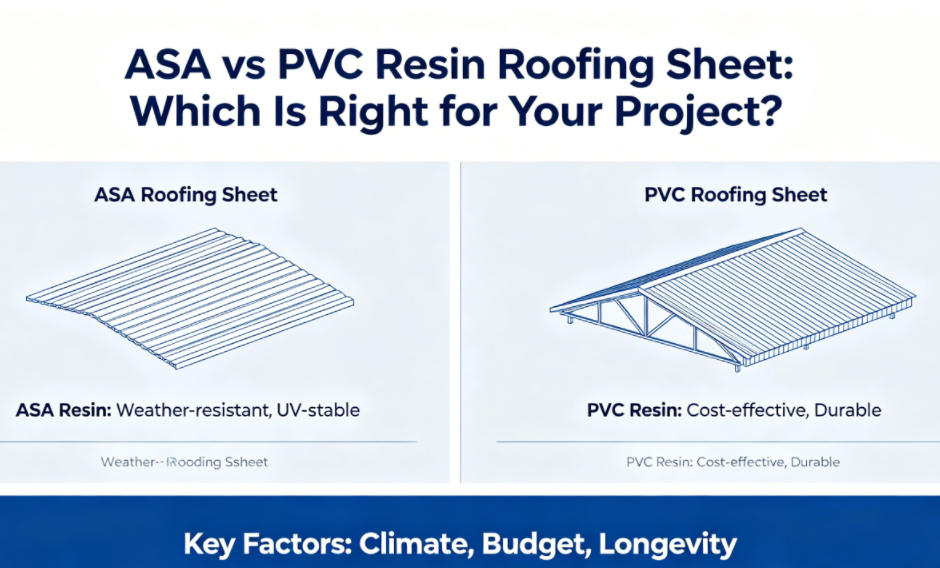
Entrambi i prodotti sembrano simili su una scheda tecnica. Entrambi sono leggeri, resistente alla corrosione, e significativamente più economico delle piastrelle in metallo o argilla. La differenza tra loro è invisibile al momento dell’acquisto e molto visibile dopo cinque anni di vita del tetto.
La domanda fondamentale non è quale materiale sia migliore. It’s which one is right for how long your building needs to perform, where it’s located, and what the roof will be exposed to. Here’s what actually separates the two.
What Makes Them Different at the Material Level
PVC Resin Roofing Sheet
PVC roofing sheet is a single-layer product. The base material is polyvinyl chloride resin, mixed with stabilisers, flame retardants, and functional fillers. The single-layer structure keeps manufacturing costs low. It also means the surface that faces the weather is the same material throughout — there is no dedicated protective layer.
Sotto esposizione prolungata ai raggi UV, Il PVC si ossida. The surface fades, becomes brittle, and loses structural integrity. Nei climi moderati, this process takes 10–15 years. In ambienti con raggi UV elevati: sud-est asiatico, il Medio Oriente, northern Australia, southern China — visible degradation can appear within three to five years.
ASA Resin Roofing Sheet
ASA roofing sheet is a composite structure. It uses PVC as the base for durability and structural performance. On top of that, a co-extruded ASA (Acrilonitrile stirene acrilato) layer is bonded permanently to the surface.
This ASA layer is what changes the performance equation. It blocks 99% delle radiazioni UV. It resists acid, alcali, e corrosione del sale. It retains colour and surface integrity for 20–30 years in conditions that would degrade standard PVC within a decade.
The ASA layer is not a coating applied after manufacturing. It is co-extruded — meaning it bonds at a molecular level during production. It doesn’t peel or delaminate.
Performance Comparison: The Numbers That Matter
| Performance Factor | PVC Resin Roofing Sheet | ASA Resin Roofing Sheet |
|---|---|---|
| UV and weather resistance | Fades and degrades under sustained UV. Poor colour retention after 3–5 years in high-sun environments | Blocks 99% of UV. Retains 95% of original colour after 10 years of direct sun exposure |
| Vita utile | 10–15 years in moderate climates. Shorter in harsh or high-corrosion environments | 20–30 years. Holds performance across a wider range of climates and exposure conditions |
| Colour options and retention | Limited colour range. Appearance deteriorates relatively quickly | Wide colour range. Colour stability backed by 10-year warranty on quality products |
| Corrosion resistance | Good. Designed for basic corrosion protection in standard environments | Excellent. Retains full PVC corrosion resistance plus additional weather protection from the ASA layer |
| Flame resistance | Standard flame retardant performance | Retains PVC flame retardant properties. Class B fire rating on quality products |
| Unit cost | Lower upfront cost | 20–50% higher than PVC. Lower total cost of ownership over 20+ anni |
The Cost Comparison Over Time
The 20–50% price premium for ASA over PVC looks significant at the point of purchase. Over a 20-year window, the arithmetic changes.
A PVC roof in a moderate climate needs replacement after 10–15 years. That means one full replacement cycle — new materials, new installation, disposal of the old roof — within the period that a quality ASA roof would still be performing. The replacement cost alone typically exceeds the original price premium of ASA.
In harsh climates, high-UV environments, or coastal and industrial settings, PVC degrades faster. The replacement cycle shortens. The cost comparison shifts further in favour of ASA.
For temporary structures or short-cycle projects where the building itself won’t be in use for more than 10 anni, PVC’s lower upfront cost is the rational choice. For anything intended to last longer, the total cost of ownership calculation favours ASA.
Which One Is Right for Your Project
Choose PVC resin roofing sheet when:
The building has a short intended service life — temporary construction site sheds, farmers’ market structures, basic storage warehouses, or simple carports where the roof doesn’t need to outlast the project. Appearance requirements are minimal. Budget is the primary constraint and long-term performance isn’t the priority.
Choose ASA resin roofing sheet when:
The roof needs to perform for 20+ anni. The building is in a high-UV, costiero, humid, or industrial atmosphere environment. Colour and appearance matter — residential homes, ville, scenic area buildings, or commercial properties where aesthetic degradation is a problem. The project is a flat-to-slope conversion or renovation where another replacement cycle would be disruptive and expensive.
A practical rule:
If you’re asking whether ASA is worth the premium, the question to answer first is: how long does this roof need to last, and in what conditions? For anything beyond 15 years in a real outdoor environment, ASA is almost always the lower total cost option.
Domande frequenti
How much longer does ASA resin roofing sheet last than PVC?
ASA typically achieves 20–30 years. PVC runs 10–15 years in moderate climates and shorter in harsh or high-UV environments. In practical terms, a quality ASA roof will outlast two PVC replacements over the same period — which is where the total cost comparison shifts significantly.
Is the higher upfront cost of ASA worth it?
For any project with a service life beyond 15 years — yes. The replacement cost of a PVC roof within that window, including materials, installazione, and old roof disposal, typically exceeds the original price difference. For short-cycle temporary structures, PVC is the more rational choice.
How does ASA handle UV exposure compared to PVC?
The ASA surface layer blocks 99% of UV radiation and maintains structural and aesthetic performance for 10+ years in high-sun environments. PVC lacks this dedicated protective layer. In Southeast Asia, il Medio Oriente, Australia, and similar high-UV climates, PVC shows visible surface degradation within three to five years. ASA holds colour and structural integrity across the same period.
Do both materials offer corrosion resistance?
Both resist acids, alkalis, umidità, and chemical exposure. ASA retains the full corrosion resistance of its PVC base and adds the weather protection of the ASA surface layer. For coastal environments with constant salt spray, or industrial facilities with chemical fume exposure, ASA’s additional protection layer makes it the more durable specification.
What projects are PVC resin roofing sheets genuinely suited for?
Short-term, low-visibility projects where budget is the primary constraint. Temporary site sheds, basic agricultural storage, simple carport covers, and structures with a planned service life under 10 anni. For these applications, paying the ASA premium for long-term performance you won’t use doesn’t make financial sense.