
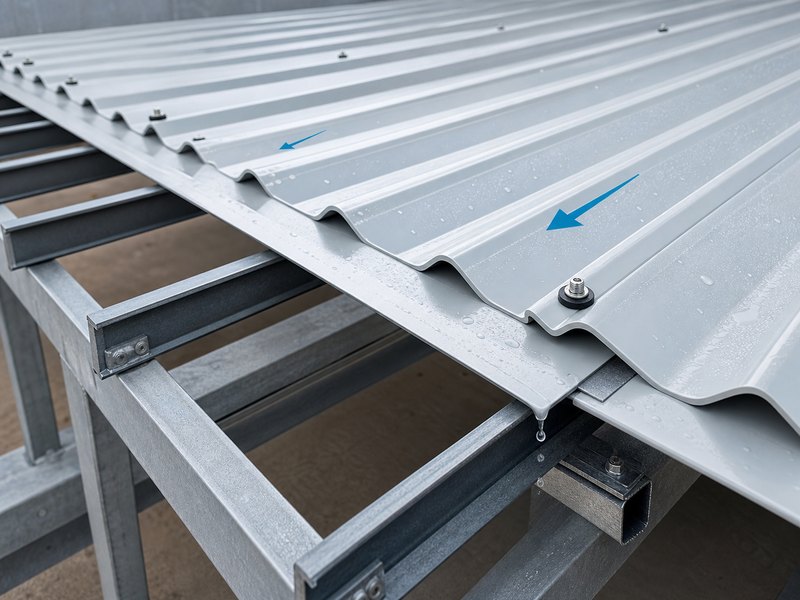
PVC roofing sheets leak when rain finds a path through the roof system. The sheet material may still look normal. The cause often sits in one detail: pendiente, superposición, presión del sujetador, condición de la lavadora, espaciado de soporte, or heat movement.
HESU treats a lámina para techos de PVC as a water-shedding roof component, not as a flat waterproof membrane. That distinction matters. A membrane tries to hold water in place. A profiled roofing sheet must move water away from laps, screw holes, uniones de paredes, and ridge lines.
Where does a leak start?
The first leak path often begins as poor drainage. A low roof pitch slows the water film on the sheet surface. Polvo, leaf fragments, or small installation debris can then hold water near an end lap. Once water sits at a lap, capillary action can pull moisture into a narrow gap. Wind can also push rain uphill across the profile.
Profile shape changes this behavior. A deeper corrugation gives water a clearer channel. A shallow wave needs more care around side overlap and screw placement. Its high point and low point sit closer together. HESU normally studies the sheet profile, lluvia esperada, and roof length together before treating leakage as a material problem.

Why do slope and overlap matter?
Side overlap and end overlap perform different jobs. Side overlap controls water crossing from one sheet to another. La superposición final controla el agua que se mueve a lo largo del techo.. When roof pitch is too low, the end lap becomes the weak point. Water moves slowly there and stays under wind pressure for longer.
Overlap length also changes with sheet profile and roof condition. A short end lap may work on a steep roof with a short drainage run. The same lap can fail on a long, low-slope roof. HESU Guía de instalación de láminas para techos de PVC explains the relationship: drenaje, lap direction, posición del sujetador, and thermal allowance must support each other.
How do fasteners create leaks?
A screw hole is the most obvious opening in a plastic roofing sheet. It only stays dry when the screw, arandela, hoja, and support line up correctly. The washer must compress enough to seal the hole. It must not cut into the sheet surface or distort the wave.
Over-tightening causes many hidden problems. It can flatten the corrugation around the screw head. It can also stretch the hole and leave a stressed ring in the PVC sheet. Under hot daytime conditions, the sheet expands. At night, it contracts. If the screw locks the sheet too tightly, movement concentrates at the hole. The leak path slowly grows.
Under-tightening causes a different issue. The washer may lift during wind vibration, and rain can move under the edge. A clean fixing point sits square to the sheet and lands on a stable purlin. It keeps the washer evenly compressed. That small detail often matters more than a thicker sheet.
Why does purlin spacing affect sealing?
Purlins support the sheet, control sagging, and give each screw a stable base. When spacing is too wide, the sheet can flex between supports. Flexing changes the overlap gap and adds stress around fasteners. During heavy rain or wind, that movement can pump water through a small opening.
Support spacing also affects the visible roof line. A sheet that sags between purlins can hold water near a lap or near a screw washer. The roof may not leak during the first rain. Repeated wetting, heating, and cooling can make the weak point larger. From a factory technical view, correct purlin spacing protects the roof profile.
How does heat movement affect PVC sheets?
PVC expands under heat. Long sheets show this movement more clearly than short sheets. Expansion accumulates along the sheet length. A roof in strong sun can move during the day and then pull back after sunset. The fastening system must allow that movement without losing seal pressure.
Pre-drilled holes, correct screw position, and controlled washer pressure help the sheet move without losing seal pressure. Rigid fixing may look neat at installation, but it can become risky during strong daily temperature swings. This is also why HESU separates PVC and Hoja de techo de UPVC discussions. Rigidez, formulación, perfil, and application environment can change roof movement.
What roof edges should be checked?
Water rarely respects the boundary between a sheet problem and a roof-detail problem. Tapas de cumbrera, tapajuntas de pared, alero, valles, and side closures can all send water back under a sheet. The leak may appear near a screw. The real path can start at a wall junction several meters above it.
Condensation can also look like leakage. Warm indoor air can meet a cooler roof surface and form droplets under the sheet. This risk grows in humid buildings with poor ventilation. It does not mean the outer sheet failed. It means the building envelope needs better airflow, insulation planning, or moisture control.
What is HESU’s practical rule?
A reliable PVC roofing sheet roof starts with a simple rule: move water away before it can test the weakest detail. Steeper drainage, suitable overlap, accurate screw placement, stable support, and heat-movement allowance all serve that rule.
Material quality still matters. Stable thickness, forma de perfil limpio, consistent color layer, and careful packing help the sheet arrive and install correctly. Yet leakage prevention depends on the installed roof system. A good PVC sheet cannot compensate for a roof that traps water at laps or locks every fastener against thermal movement.
For HESU technical content, the most useful question is not whether PVC roofing sheets leak. Any roof material can leak when the system details fail. The better question is whether the roof gives the sheet fair working conditions: enough slope, enough overlap, enough support, and enough movement room.