
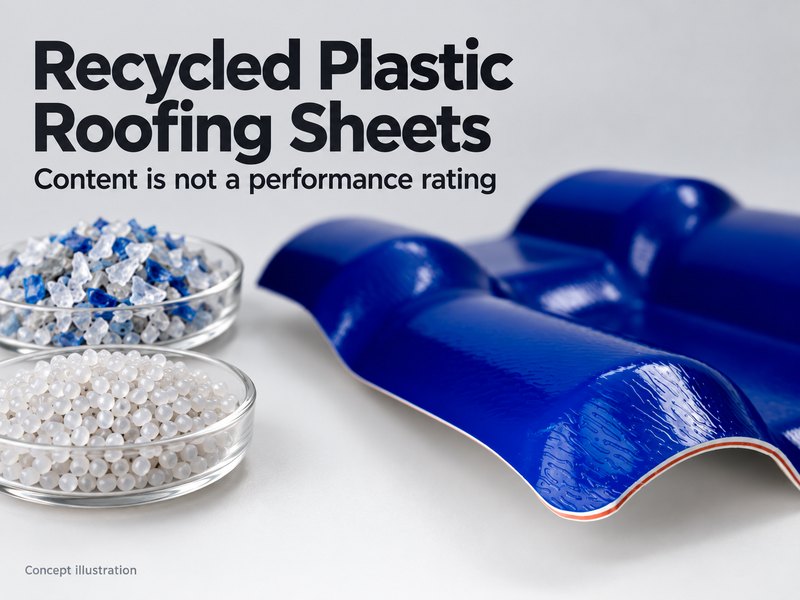
Recycled plastic roofing sheets use recovered plastic as part or all of their material feedstock. They can serve as roof coverings when the finished product meets its intended outdoor requirements. Recycled content alone does not establish strength, heat resistance or service life. The polymer, formulation and finished sheet construction determine those properties together.
The useful distinction is between where the material came from y what the roof sheet can do. A high recycled percentage answers the first question. It does not automatically answer the second.
Start with the plastic, not the percentage
Recycled plastic is not one material grade. Recovered PVC, polyethylene and polypropylene have different processing behavior and mechanical properties. Even two batches of the same polymer can contain different pigments, fillers and stabilizers.
Sorting therefore does more than remove visible dirt. It separates material families and helps control the composition entering the next manufacturing cycle. Incompatible plastics can create weak interfaces instead of a uniform material. A clean appearance cannot establish chemical compatibility.
NIST’s explanation of material identification describes how recyclers distinguish polymers through their response to light. It also explains why the polymer name does not describe every ingredient in a plastic product.
The same distinction applies to finished roofing names. A teja de plastico describes a product family, not a recycled-content grade. Its tile shape and color reveal little about the origin of its raw material.
What a recycled-content figure actually describes
Pre-consumer material comes from material recovery during manufacturing. Post-consumer material comes from products that have completed their use. Those histories matter because recovered material may carry previous additives, contamination or outdoor exposure.
Production offcuts and mixed demolition waste therefore do not present the same starting conditions. Sin embargo, neither label alone guarantees consistent quality. Identificación, separation and formulation control still matter.
A percentage also needs a clear denominator. Consider this hypothetical mass-based example, not a HESU specification:
- A finished sheet weighs 10 kilos.
- Its core accounts for 8 kilos, incluido 4 kg of qualifying recovered material.
- The remaining 2 kg contains no recovered material.
The core contains 50% recovered material: 4 ÷ 8 × 100. The whole sheet contains 40%: 4 ÷ 10 × 100. Calling the entire sheet 50% recycled would confuse the core with the complete product.
This distinction also matters when a claim refers only to the polymer fraction rather than all sheet ingredients. Thickness fractions cannot replace mass fractions when the layers have different densities.
A new surface does not reset the material underneath
Multilayer construction lets manufacturers assign different functions to the exposed surface and supporting body. The surface can provide weathering protection or color. The body contributes to the sheet’s overall mechanical behavior.

A visible dark core does not prove recycled content. Pigment can create the same appearance in virgin material. Likewise, a pale core does not prove virgin origin. The photograph illustrates a visible layered edge, not a method for identifying feedstock.
For a lámina para techos de PVC, material formulation and sheet construction remain separate from the recycled-content declaration. PVC identification alone does not specify the additive package, layer arrangement or outdoor performance.
The factory-side implication is straightforward: changing the feedstock requires attention to the resulting compound, not just the surface finish. Previous processing and exposure can change a recovered polymer. A protective face cannot compensate for every change in the supporting body.
Recycled does not automatically mean weaker
There is a real difference between saying that recycling can change properties and saying that recycled material must perform poorly.
en un 2024 study, Drozdov and colleagues compared selected virgin and post-consumer HDPE grades with similar short-term mechanical properties. Their model produced closely matching stress-versus-time-to-failure predictions under creep conditions. Creep means gradual deformation under a sustained load.
That finding supports material-specific comparison rather than a blanket rejection of recycled polymers. It does not establish a roof lifespan: the study concerned selected HDPE materials and modeled behavior, not HESU roofing.
The reverse shortcut also fails. A larger recycled fraction does not prove equal impact resistance or better outdoor durability. Finished-product results must connect the material choice to the actual roof application.
Stiffness alone can mislead. NIST research on HDPE weathering found increasing stiffness alongside reduced elongation at failure during exposure. En términos prácticos, a material can feel harder while becoming less tolerant of deformation before breaking.
This is why a simple hand-flex demonstration cannot describe long-term performance. La explicación de HESU de plastic roofing weathering test results covers the difference between exposure duration and measured property changes.
What changes when the material becomes a roof covering
A material sample and a complete roof sheet answer different questions. A tensile specimen describes behavior under a defined pull. A roof covering also encounters attachment forces, temperature changes, impact and water at its joints.
EOTA’s EAD 220010-01-0402 illustrates this distinction for small-format flat recycled-plastic roof coverings. Its assessment topics include impact, flexural behavior, fastener pull-through, Estabilidad UV, temperature resistance and water penetration. The document is not a universal certification for corrugated sheets, and it does not certify HESU products.
The important lesson is the breadth of the product assessment. A recycled-content declaration cannot substitute for these separate functions. Neither can a good result in one property establish all the others.
Recycled content and future recycling are different promises
Recycled content concerns material already incorporated into the sheet. Recyclability concerns a future route for collecting and processing it. A sheet can contain recovered material without having a practical local recycling route after removal.
The US FTC treats these as separate environmental claims. Its guidance also distinguishes partial recycled content from an unqualified whole-product claim. These distinctions help keep material descriptions precise without turning an environmental attribute into an overall performance claim.
From a roofing-manufacturing perspective, the aim is useful material recovery without losing the functions the roof needs. The recycled percentage and the finished-product performance should remain two clear statements. Together they tell a more useful story than either one alone.