
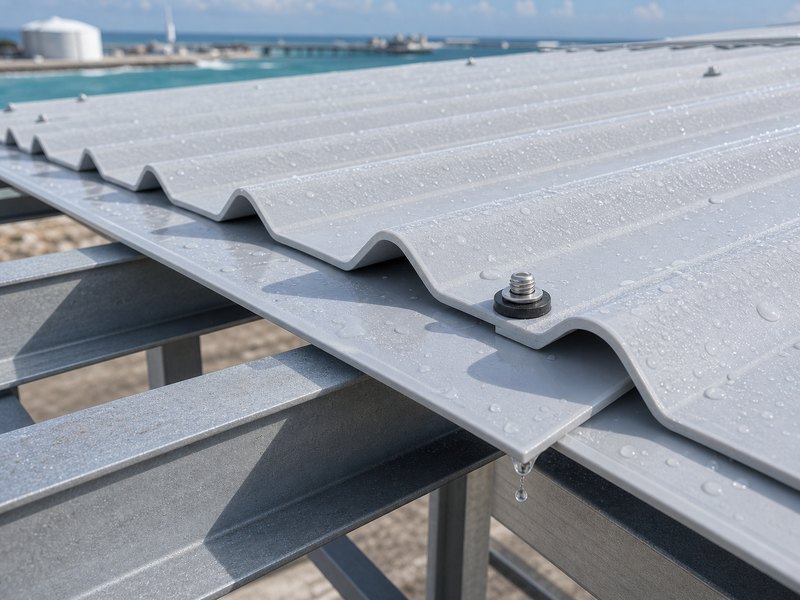
UPVC roofing sheets can work well in coastal areas when the roof system controls salt, رطوبة, fastener stress, and drainage. The sheet body itself does not rust like exposed metal roofing. Yet coastal performance still depends on the parts around the sheet: screws, غسالات, مدادات, flashing, يتداخل, تهوية, and roof slope.
HESU views coastal roofing as a system question. Salt air attacks weak details first. Standing water leaves deposits at laps. Humid indoor air can form condensation under the roof. A good roof design keeps these pressures separated instead of asking one material to solve every problem.
Why does UPVC matter near salt air?
UPVC يعني كلوريد البوليفينيل غير الملدن. Compared with softer PVC systems, UPVC has a more rigid structure. That rigidity helps the sheet hold profile shape when the roof needs stable drainage channels and clean overlap lines.
The main coastal advantage is simple: the plastic body of an ورقة تسقيف UPVC does not corrode in the same way as exposed steel sheet. Salt air can still affect metal screws, support members, ومضات, and cut edges on metal accessories. That is why HESU studies the full roof assembly, not only the visible sheet surface.
UPVC also has limits. It still expands and contracts under heat. It still needs suitable support spacing. It still depends on correct fixing pressure. Coastal sunlight, رطوبة, and wind can make those details more important because the roof faces repeated wet and dry cycles.

How does salt spray behave on a roof?
Salt spray rarely arrives as one clean event. Wind carries fine salt particles onto the roof surface. Sea mist can dry into small crystals. Rain can wash many crystals away, but deposits may remain under side laps, near screw washers, at eaves, and around wall junctions.
Those deposits matter because they hold moisture. A dry-looking roof can still carry salt in small protected areas. When humidity rises at night, the deposits can attract moisture again. This cycle creates a harder environment for metal fasteners and accessories than for the UPVC sheet body.
Roof profile affects the amount of residue that remains. A clean corrugated channel helps rain move salt downward. A low-slope roof holds water longer. A poorly aligned overlap can trap deposits. HESU’s factory-side view starts with the sheet profile, but it does not stop there.
Why are fasteners critical in coastal roofing?
Fasteners often decide the service behavior of a coastal plastic roof. The sheet may resist corrosion, but a weak screw or aging washer can open the first water path. The washer must seal the hole, remain flexible, and keep pressure without cutting into the sheet wave.
Correct screw pressure matters. Over-tightening can distort the UPVC profile and stress the hole. Under-tightening can let wind vibration lift the washer edge. Both conditions allow salt and water to sit around the fixing point. The same movement logic appears in HESU’s PVC roofing sheet installation guide, where washer pressure and thermal allowance work together.
The fastener material also needs attention. In coastal air, exposed metal parts face salt and humidity every day. Matching the screw, غسالة, support member, and roof environment reduces weak points. HESU treats the fastener as part of the roof specification, not as a small accessory afterthought.
How do slope and overlap affect salt deposits?
Slope controls how long salt and water remain on the roof. A steeper drainage path moves rain and residue faster. A low slope gives moisture more time to sit at end laps, screw lines, and shallow channels.
Side overlap controls cross-flow between sheets. End overlap controls water moving down the roof length. In coastal wind, rain can travel sideways or upward for short distances. A clean overlap direction, enough lap length, and stable purlin support help the roof shed water before salt deposits collect in hidden gaps.
Effective coverage also matters. Total sheet width is not the installed coverage width after overlap. If a roof layout ignores effective coverage, the final sheets may need awkward trimming. Awkward trimming can create rough edges, tight joints, or forced alignment. Those small details give salt and water more places to stay.
What role does ventilation play?
Coastal roofs manage moisture from two sides. Outside, salt spray and rain hit the top surface. Inside, humid indoor air can rise and meet the underside of a cooler sheet. When that air cools, condensation can form.
Condensation is not the same as roof leakage. Water droplets under the sheet may come from indoor humidity, poor airflow, or missing insulation planning. Building-envelope logic matters here. Air movement, ridge detail, eave opening, and ceiling design can change moisture behavior below the roof.
Ventilation also protects support members and fasteners. UPVC may not rust, but the roof frame, screw points, and flashings still need dry conditions. A roof that traps humid air below the sheet can create corrosion risk around metal parts even when the plastic sheet remains stable.
How does UPVC compare with PVC in this application?
PVC and UPVC both belong to the vinyl family, but they do not behave exactly the same. أ ورقة تسقيف PVC may offer flexibility and simple installation for many agricultural, light commercial, and industrial uses. UPVC usually emphasizes rigidity and shape stability.
In coastal applications, rigidity can help the roof profile stay clean under support and drainage loads. Flexibility can help during handling and installation. The right material logic depends on profile design, سماكة, تباعد الدعم, roof length, and local heat. HESU separates the two materials because coastal roofs stress both surface behavior and structural shape.
What does HESU control before the sheet reaches the roof?
Factory control starts with stable extrusion. A consistent profile gives rain a predictable drainage path. Stable thickness helps the sheet keep shape across purlins. Clean edges, balanced cooling, and controlled packing reduce stress before installation begins.
Packing also matters for coastal projects. Long sheets need even support during transport. Tight straps can mark edges if the load shifts. Moisture trapped in packaging can leave surface marks before installation. HESU treats packing and loading as part of product performance because damaged edges often become installation problems later.
The practical rule is clear: coastal roofing performance comes from corrosion-resistant sheet material plus dry, stable, well-drained roof details. UPVC helps remove one major risk from the sheet body. The remaining risks sit in fasteners, يتداخل, تهوية, metal accessories, and workmanship. A coastal roof performs best when all of those details support the same drainage and moisture-control strategy.